


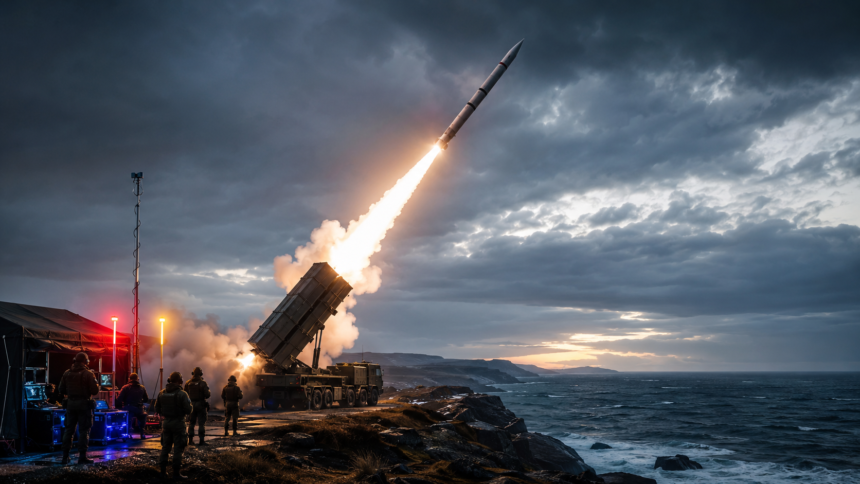
Germany has successfully tested an Israeli-made ballistic missile in the North Atlantic, marking an important step in Berlin’s efforts to expand its long-range strike capabilities and strengthen European deterrence.
German officials said the trial involved the LORA missile system developed by Israel Aerospace Industries. The weapon can reportedly strike targets at distances of up to 500 kilometres, offering Germany a ground-launched capability beyond much of its current missile inventory.
The successful test is particularly significant because Germany does not currently operate an equivalent ballistic missile system. If acquired and deployed, LORA would allow German forces to engage strategically important targets from considerable distances without relying exclusively on aircraft-launched weapons.
The system is designed to strike fixed and relocatable targets, including command centres, air-defence positions, logistics facilities and military infrastructure. It can be launched from mobile platforms, increasing its operational flexibility and making it more difficult for an adversary to identify and neutralise before deployment.
The trial comes as Germany undertakes its most extensive military modernisation programme in decades. Russia’s invasion of Ukraine and mounting concerns about the security of European infrastructure have encouraged Berlin to increase defence spending and strengthen its missile, air-defence and surveillance capabilities.
German Navy Chief Vice Admiral Jan Christian Kaack described the test as an important development for the country’s deterrence and defence readiness. Long-range precision weapons are increasingly viewed as essential for preventing attacks by demonstrating an ability to respond against military targets located far behind hostile lines.
The test also reflects a broader European effort to reduce capability gaps exposed by the war in Ukraine. Several European governments are investing in longer-range missiles, integrated air-defence networks and systems capable of countering drones and ballistic weapons.
Germany is simultaneously participating in multinational missile-development projects and modernising its air-launched Taurus cruise missile. An upgraded version, known as Taurus NEO, is expected to become available toward the end of the decade.
The existing Taurus system has a range comparable to that of LORA but must be launched from a combat aircraft. A ground-launched ballistic system could provide military planners with an additional option capable of responding more rapidly and operating without exposing aircraft and pilots to enemy air defences.
Germany’s closer defence cooperation with Israel has also included the acquisition of the Arrow 3 system, which is designed to intercept ballistic missiles outside the atmosphere. Together, offensive precision weapons and advanced interception systems could form part of a more comprehensive German missile strategy.
However, the successful trial does not necessarily confirm that Berlin has reached a final procurement decision. Any acquisition would require government approval, funding and integration into Germany’s armed forces and NATO command structures.
The development nevertheless signals Germany’s intention to build a broader range of deterrence capabilities as European governments prepare for a more uncertain security environment and seek to assume greater responsibility for the continent’s defence. Reuters