

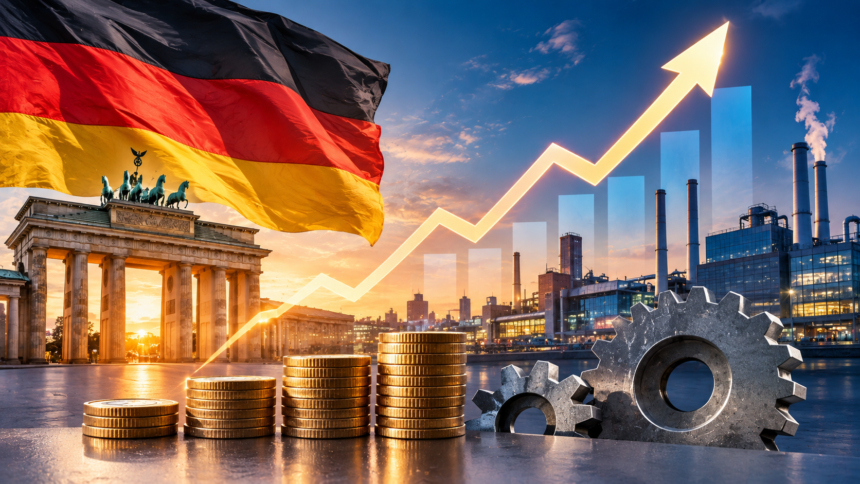
Germany’s economy is showing stronger signs of recovery, with better-than-expected growth and improving business confidence providing fresh optimism for Europe’s largest economy after a prolonged period of weak performance.
Official data released Tuesday showed that German gross domestic product expanded by 0.3% in the second quarter of 2026, an upward revision from the preliminary estimate of 0.2%. The economy had already expanded by a revised 0.4% during the first quarter, adding to evidence that economic momentum is gradually returning.
Exports were an important driver of the second-quarter performance, rising 2% from the previous quarter. The improvement helped offset continued weakness in household consumption and investment, areas that remain important challenges for a broader and more sustainable recovery.
Positive signals also emerged from Germany’s business sector. The Ifo Business Climate Index climbed to 88.8 points in August, up from a revised 86.7 in July and comfortably above economists’ forecast of 87.2. It was the strongest reading in around a year.
Companies became more optimistic about the months ahead, with the Ifo expectations index rising to 89.1 from 86.8. Businesses also reported an improvement in their assessment of current conditions, while sentiment strengthened across economic sectors.
Recent industrial indicators have added to the cautiously positive picture. Germany’s manufacturing sector expanded in August, with the manufacturing PMI reaching 54.1, its highest level in more than four years, although weakness persisted in the services sector.
The recovery remains exposed to significant risks. Higher energy costs, geopolitical uncertainty and weak domestic demand could still restrain growth, while Germany continues to deal with longer-term structural challenges affecting its industrial competitiveness.
Nevertheless, the combination of stronger GDP growth, improving exports and rising business confidence suggests that Germany may finally be gaining momentum after years of economic stagnation. For Chancellor Friedrich Merz’s government, the latest figures also strengthen hopes that increased infrastructure and public investment can help sustain the recovery through the remainder of 2026.