


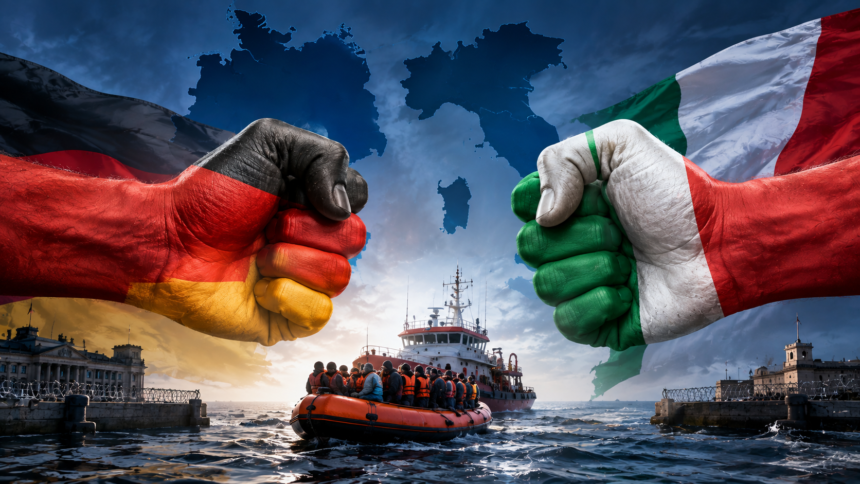
Tensions between Germany and Italy over migration have intensified as the two European Union members clash over migrant rescue operations in the Mediterranean and responsibility for people brought ashore by humanitarian vessels.
The latest dispute was reignited after Italian authorities detained the German-operated rescue vessel Sea-Watch 5 for 45 days and imposed a €7,500 fine. The ship had rescued six people in the Mediterranean on August 13, but Italian authorities accused its crew of failing to properly inform the Libyan coastguard about the operation.
Sea-Watch disputes the Italian government’s account. The German rescue organisation says Italy’s Maritime Rescue Coordination Centre never instructed its crew to contact Libyan authorities and that the Libyan coastguard was already present in the area and communicated with the vessel by radio. The organisation plans to challenge the detention.
But the controversy extends far beyond a single rescue ship. Rome argues that German humanitarian organisations operating in the Mediterranean have placed a disproportionate burden on Italy by rescuing migrants and subsequently disembarking them at Italian ports.
Figures released by Italy’s Interior Ministry indicate that approximately 42,300 people arrived at Italian ports aboard private rescue vessels between October 2022 and August 2026. Around 22,500 were transported by German NGOs, representing more than half of those arrivals. When vessels operated by other organisations but sailing under the German flag are included, Rome calculates that German-linked ships account for nearly two-thirds of arrivals involving private rescue vessels.
Italian Interior Minister Matteo Piantedosi has consequently called on Germany to contribute financially toward the costs associated with migrants brought to Italy by German organisations. The issue has become linked to another contentious question: whether Italy should accept asylum seekers returned from Germany after initially entering the European Union through Italian territory.
Deputy Prime Minister Matteo Salvini has taken an even harder position, saying Italy should not accept migrant returns from Germany while German humanitarian organisations continue transporting rescued people to Italian ports.
Berlin, meanwhile, points to European migration rules governing responsibility for asylum applications and argues that cooperation between EU countries is necessary. Germany wants transfers of some asylum seekers back to Italy to resume when Italy was their original country of entry into the bloc.
At the centre of the disagreement is a broader legal and political debate over who bears responsibility after a rescue at sea. Humanitarian organisations maintain that their operations are essential to preventing deaths along one of the world’s most dangerous migration routes. Italy’s government argues that repeated NGO operations followed by disembarkations at Italian ports unfairly transfer the consequences of migration onto frontline Mediterranean states.
The growing Berlin-Rome dispute therefore represents more than a disagreement over rescue vessels. It exposes persistent divisions inside the European Union over how responsibility for irregular migration should be divided between countries of first arrival and northern European destinations.
With the two governments’ interior ministers seeking a common approach, the outcome could become an important test of whether Europe’s new migration framework can prevent bilateral disputes over asylum transfers, maritime rescues and responsibility for new arrivals from escalating further.