

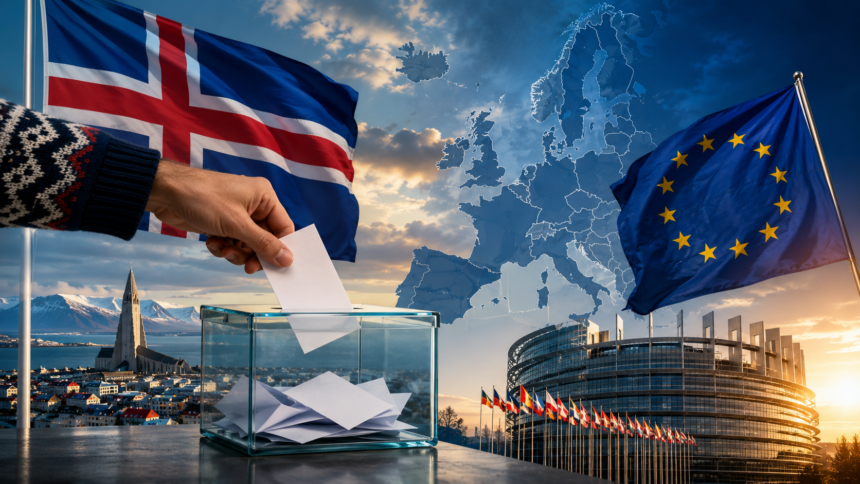
The European Union is closely watching Iceland ahead of an August 29 referendum that will determine whether the Nordic country should resume negotiations to join the bloc, with European diplomats viewing a “Yes” result as potentially providing fresh momentum to the EU’s broader enlargement agenda.
Icelanders will not be voting directly on EU membership. Instead, voters will answer a more limited question: whether Iceland should resume accession negotiations with the European Union. If voters approve restarting the talks and negotiations eventually produce an agreement, Icelanders would have another opportunity to decide on actual membership in a second referendum.
The August 29 vote was approved by Iceland’s parliament in May. Iceland originally applied to join the EU in 2009, following the global financial crisis, and formal accession negotiations began the following year. The process stalled after a more Eurosceptic government took power in 2013.
The issue has returned to the political agenda amid changing economic and geopolitical conditions. The war in Ukraine, increasing strategic competition in the Arctic and concerns about global trade have strengthened arguments among supporters that Iceland should have a greater voice in European decision-making. Iceland already participates extensively in the European single market through the European Economic Area, but it does not have voting rights inside EU institutions.
For Brussels, the significance extends beyond Iceland itself. Reuters reported that EU diplomats believe a positive vote from a prosperous Nordic democracy could improve the political atmosphere surrounding enlargement at a time when countries including Montenegro, Albania, Ukraine and Moldova are pursuing membership.
The argument is partly political. Enlargement has faced resistance in some EU member states because of concerns about migration, budgets, agriculture and the cost of integrating less wealthy countries. Iceland, with a population of roughly 400,000 and a highly developed economy, would present a very different accession case. European diplomats therefore believe its return to negotiations could help reinforce the idea that EU membership remains attractive even to wealthy Western European states.
However, the Icelandic public remains deeply divided. Reuters reported this week that polling showed 46% supporting the resumption of negotiations and 46% opposing it, with 8% undecided, making the referendum highly competitive. Opposition to actually joining the EU remains stronger than opposition to merely restarting negotiations.
One of the most difficult issues is expected to be fisheries, a strategically and culturally important sector for Iceland. Opponents fear EU membership could weaken national control over fishing resources and quotas. Independence Party leader Guðrún Hafsteinsdóttir has argued that EU membership is not necessary to solve Iceland’s economic or security challenges and that the country can maintain close cooperation with Europe without joining the bloc.
Supporters, meanwhile, argue that closer integration could strengthen Iceland economically and geopolitically. Foreign Minister Þorgerður Katrín Gunnarsdóttir has said Iceland could potentially become an EU member as early as 2028 if voters approve renewed negotiations and subsequent talks progress successfully. She has acknowledged that fisheries and agriculture would likely be among the toughest negotiating areas.
The referendum therefore represents more than a procedural decision about reopening negotiations. It has become a debate over Iceland’s long-term position between maintaining its existing independent relationship with Europe and moving toward full participation in the EU.
For the European Union, meanwhile, a “Yes” vote could carry symbolic weight far beyond Iceland’s shores. With Brussels attempting to revive an enlargement process stretching from the Western Balkans to Ukraine and Moldova, Iceland’s decision to return to the negotiating table could provide the bloc with a timely political signal that European integration continues to attract new members.
On August 29, however, that decision will belong to Icelandic voters — and even a victory for the “Yes” campaign would mark only the beginning of a potentially lengthy accession process, not Iceland’s immediate entry into the European Union.