


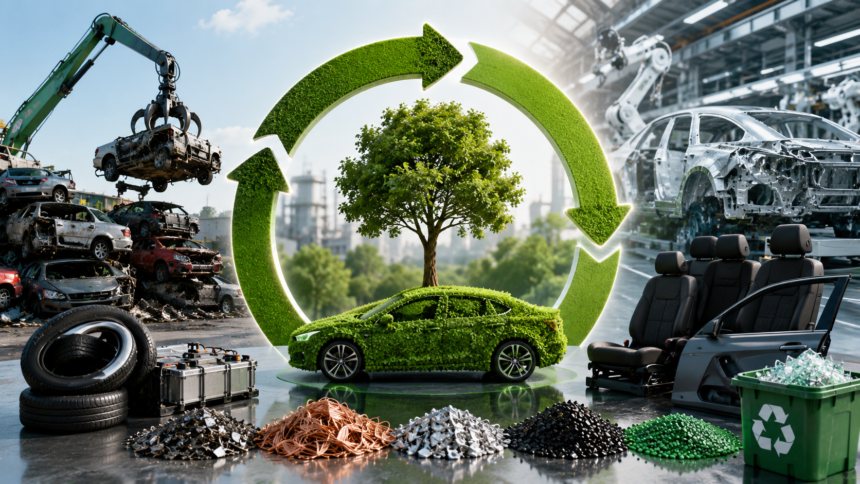
The European Union’s new rules governing end-of-life vehicles enter into force today, August 13, marking a major overhaul of how cars are designed, manufactured, dismantled and recycled across Europe. The legislation is intended to make the automotive industry more circular while keeping valuable materials inside the European economy and reducing dependence on imported raw materials.
The new End-of-Life Vehicles Regulation replaces and modernizes rules dating back more than two decades. It connects vehicle design with what happens to a car once it reaches the end of its useful life, encouraging manufacturers to think about reuse, dismantling and recycling from the earliest stages of production.
One of the central changes concerns recycled materials in new vehicles. Under the new framework, new vehicle types will eventually have to contain minimum amounts of recycled plastic. The requirements will be introduced progressively, beginning with a 15% recycled-plastic target from September 2032 and rising to 25% from September 2036.
The regulation also seeks to recover more strategically important materials from scrapped vehicles. Particular attention is being given to aluminium, copper and rare-earth elements, materials that are increasingly important for electric vehicles, electronics and Europe’s wider clean-energy transition. Better dismantling and recycling could allow more of these resources to return to European manufacturing rather than being discarded or replaced with imported primary materials.
Another major element is stronger producer responsibility. Carmakers will increasingly be responsible for contributing to the costs associated with collecting and properly treating vehicles once they reach the end of their operational lives. The EU argues that making manufacturers financially responsible for this stage creates an incentive to design cars that are easier to repair, dismantle, reuse and recycle.
Authorities will also strengthen vehicle traceability. The regulation introduces clearer criteria for distinguishing a genuinely used vehicle from an end-of-life vehicle and tighter controls intended to prevent scrapped cars from disappearing into informal or environmentally unsafe treatment channels.
Exports are another important part of the reform. From mid-2031, only roadworthy vehicles will be allowed to be exported from the EU, according to the European Commission. The measure is intended to prevent vehicles that should be treated as waste from being exported to other countries under the label of second-hand cars, while also keeping recyclable materials within Europe.
The changes have an important economic dimension. Modern vehicles contain significant quantities of steel, aluminium, copper, plastics and increasingly valuable critical raw materials. Recovering more of these resources could reduce manufacturers’ exposure to volatile international commodity markets and strengthen Europe’s industrial supply chains.
The legislation is particularly relevant as Europe expands electric-vehicle production and attempts to reduce strategic dependence on external suppliers. Greater recycling means that some materials already circulating within the European economy can be recovered and used again rather than continually replaced with newly extracted resources.
However, today’s entry into force does not mean every requirement becomes immediately mandatory. The European Commission says the regulation enters into force on August 13, 2026, but will generally begin applying from September 1, 2028, with several specific obligations introduced later to give manufacturers, recyclers and national authorities time to adapt.
The new rules therefore represent a long-term restructuring of Europe’s automotive economy rather than an overnight change for motorists. By connecting vehicle design, production, ownership, dismantling, recycling and exports within a single regulatory framework, Brussels hopes to transform old cars from a growing waste problem into an increasingly valuable source of materials.
For the European Union, the objective extends beyond environmental protection: recycling vehicles more effectively is becoming part of Europe’s strategy for industrial resilience, resource security and reducing dependence on imported raw materials.