


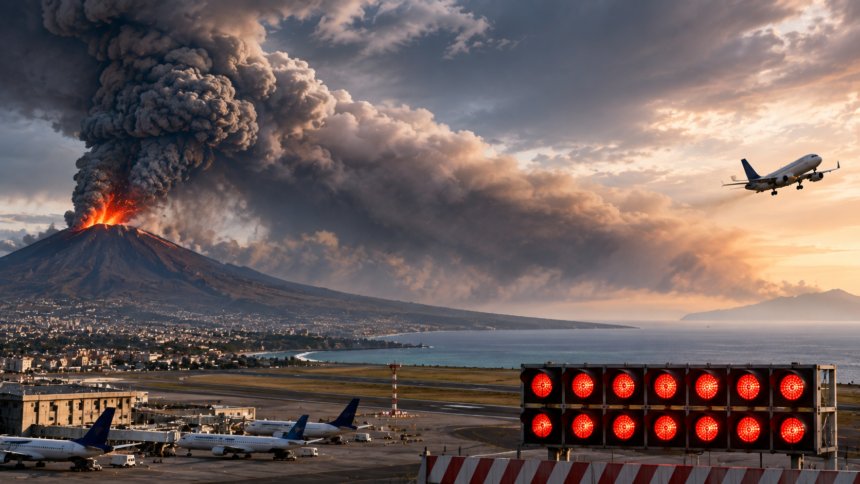
Mount Etna’s latest eruption is continuing to disrupt air travel across Sicily, with fresh volcanic ash forcing authorities to extend flight restrictions at Catania–Fontanarossa Airport while the ash plume spreads south across the Mediterranean toward Malta and Libya.
Flights at Catania were suspended again on Wednesday after renewed ash emissions made conditions unsafe for aircraft. The suspension was extended until 14:00 GMT on Thursday, August 13, as aviation authorities continued to monitor the concentration and movement of volcanic material above eastern Sicily.
The disruption comes during the peak European summer travel season, magnifying the impact on thousands of passengers travelling to and from one of Italy’s most popular tourist destinations. Catania is Sicily’s principal aviation hub and one of Italy’s busiest airports, making repeated closures particularly disruptive to the island’s transport network.
Alternative airports have consequently come under growing pressure. Palermo Airport received around 190 diverted flights, while passengers affected by the disruption have faced difficulties arranging alternative transportation across Sicily. Comiso Airport has also been used as an alternative after resuming full operations following its own temporary ash-related disruption.
The scale of the disruption has been significant. Al Jazeera reported that around 700 flights had been cancelled, leaving hundreds of passengers stranded as airlines attempted to reorganize schedules around changing volcanic conditions.
The eruption’s effects have also extended beyond Sicily. Satellite and meteorological observations cited in reports showed the volcanic ash plume moving southward across the Mediterranean, affecting the atmosphere over Malta and reaching as far as Libya.
Volcanic ash presents a serious aviation hazard because microscopic particles can damage aircraft engines, reduce visibility and interfere with critical systems. Airports therefore frequently restrict or suspend operations when ash clouds move across flight paths, even when the eruption itself poses no direct threat to airport facilities.
Mount Etna, on Sicily’s eastern coast, is Europe’s most active volcano and has a long history of disrupting aviation around Catania. Its proximity to a major international airport means changes in wind direction can quickly transform an eruption into a regional transportation problem.
The latest episode also illustrates how the consequences can spread far beyond Italy. Ash transported across the Mediterranean can affect flight routes serving Malta and North Africa, forcing airlines to adjust routes even hundreds of kilometers from the volcano.
Authorities and airport operators continue to monitor Etna’s activity and the movement of the ash cloud, while passengers have been advised to check directly with airlines before travelling.
For Sicily, the challenge remains highly unpredictable: as long as Etna continues producing significant ash emissions, changing winds can quickly trigger new restrictions, cancellations and diversions across one of southern Europe’s busiest summer aviation corridors.