

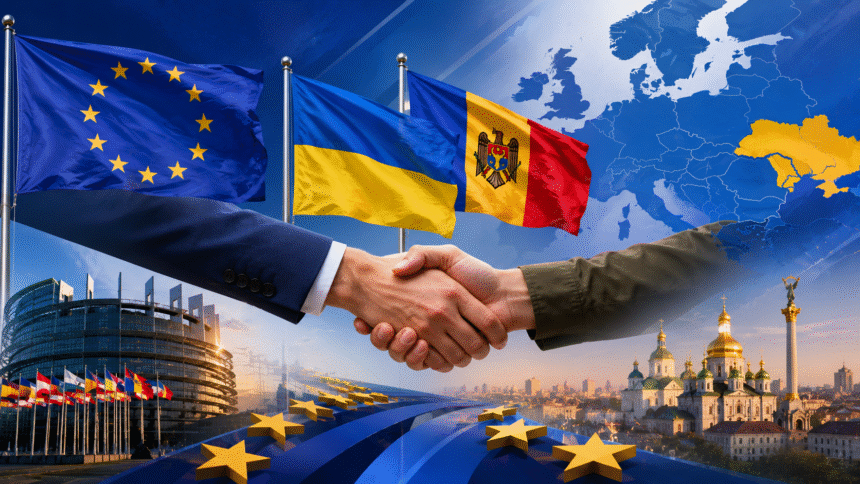
The European Union is moving closer toward formally opening accession negotiations with Ukraine and Moldova, in what officials describe as one of the most significant geopolitical shifts in Europe since the beginning of the war between Russia and Ukraine.
The European Commission announced that formal membership negotiations for both countries could officially begin during June, following months of political discussions among EU member states and European institutions.
European officials said the move reflects growing support within the bloc for deeper political, economic, and security integration with countries viewed as strategically important to Europe’s future stability.
Ukraine’s potential accession talks come amid the ongoing war with Russia, making the process highly symbolic as well as politically sensitive. European leaders have repeatedly emphasized that Ukraine’s future lies within the European family despite the continuing conflict.
“This is about Europe’s long-term security and strategic direction,” one EU official stated following the announcement. “The enlargement process has become deeply connected to the continent’s geopolitical future.”
Moldova, which has also faced increasing political and security pressure linked to the regional conflict, is expected to advance alongside Ukraine in the accession framework.
The beginning of negotiations does not guarantee immediate membership, as the accession process typically involves years of political reforms, legal harmonization, economic adjustments, and institutional evaluations across dozens of policy areas.
However, analysts say the decision itself represents a major political message directed toward Moscow, signaling that the European Union intends to strengthen ties with Eastern European states despite Russian opposition.
Ukraine officially applied for European Union membership shortly after Russia launched its full-scale invasion in 2022. Since then, Kyiv has accelerated anti-corruption reforms, legal restructuring, and alignment with European standards in an effort to advance its candidacy.
Several European leaders welcomed the announcement, describing it as a historic step toward reinforcing democratic institutions, regional cooperation, and long-term European security.
At the same time, some EU member states continue expressing concerns about the financial, political, and economic implications of future enlargement, particularly while Europe faces challenges related to defense spending, migration pressures, and economic recovery.
Russia has repeatedly criticized NATO and European Union expansion toward Eastern Europe, viewing such developments as threats to its strategic influence in the region.
Despite those tensions, European officials insist that accession decisions remain sovereign choices made by democratic nations and EU institutions.
If negotiations officially begin in June, Ukraine and Moldova would enter one of the most important diplomatic phases in their modern political history, potentially reshaping the future political map of Europe for decades to come.