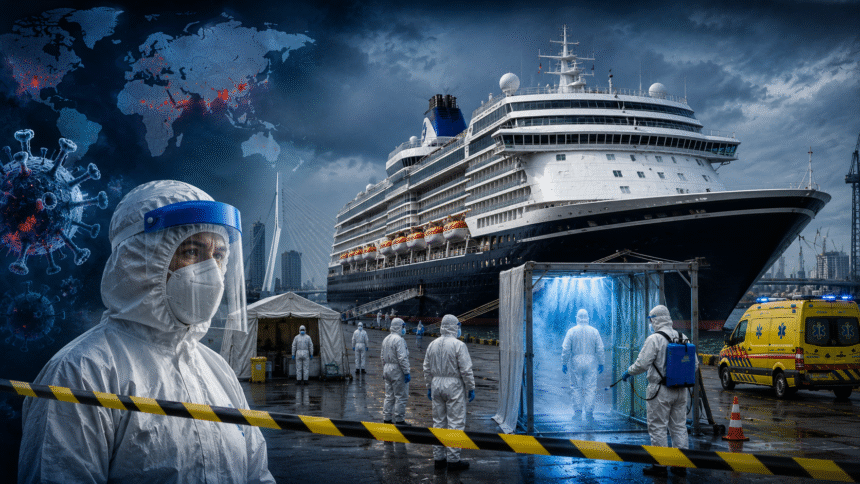
A cruise ship linked to a deadly hantavirus outbreak has arrived at the port of Rotterdam, where Dutch authorities began quarantine and disinfection measures after a health incident that placed international public health agencies on alert.
The vessel, the MV Hondius, docked in Rotterdam on Monday after passengers had already disembarked in Tenerife, Spain. According to reports, the ship arrived with 25 crew members and two medical personnel still on board. Authorities in protective gear boarded the vessel, while quarantine facilities were prepared nearby for crew members who could not immediately return home.
The outbreak involved the Andes strain of hantavirus, a virus usually associated with parts of South America. Hantaviruses are commonly spread through contact with infected rodent urine, droppings, or saliva. Health experts stress that person-to-person transmission is rare, though the Andes strain is one of the few hantaviruses known to have that possibility under close-contact conditions.
The incident has been described as the first known hantavirus outbreak on a cruise ship. Reports said the outbreak resulted in several confirmed cases and three deaths, including a Dutch couple and a German passenger. Other passengers who had been on the ship remain under medical observation in multiple countries.
Dutch health officials said none of the remaining crew members showed symptoms when the ship arrived. Still, strict health protocols were imposed, including quarantine, regular monitoring, and testing. The ship is also set to undergo a multi-day decontamination process before health inspectors decide whether it can safely return to service.
The MV Hondius had reportedly been carrying around 150 passengers and crew from more than 20 countries when a cluster of severe respiratory illnesses was reported to the World Health Organization earlier in May. The outbreak disrupted the ship’s journey and raised concern because of the international movement of passengers after disembarkation.
Public health officials have emphasized that the risk to the wider public remains low. The main concern is identifying possible exposure, monitoring former passengers and crew, and ensuring that the vessel is fully disinfected. Experts said the virus strain identified in at least one patient matched known South American strains, with no reported evidence of increased transmissibility or severity.
The arrival in Rotterdam marks the final stage of a troubled voyage that turned into a rare maritime health emergency. While authorities work to contain any remaining risk, the case has highlighted how quickly infectious disease concerns can become international when they involve cruise ships, cross-border travel, and passengers returning to different countries.