

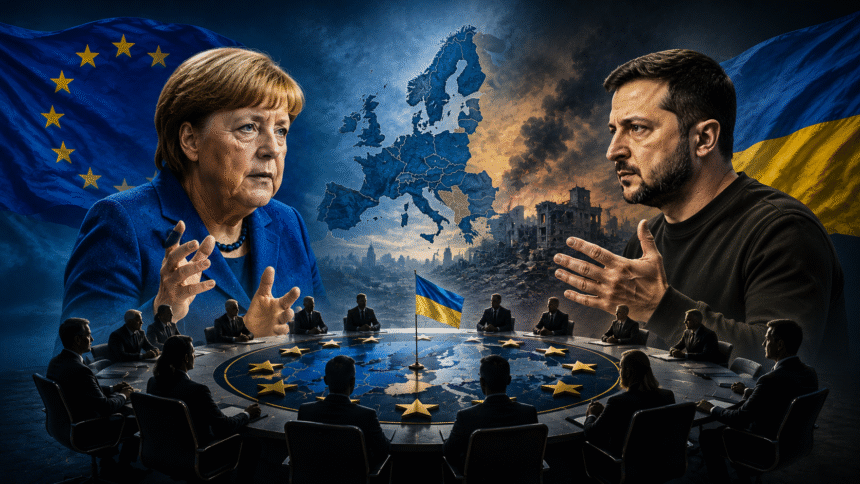
Former German Chancellor Angela Merkel has criticized Europe for failing to make full use of its diplomatic influence in dealing with Russia, arguing that the search for peace in Ukraine should not be left entirely to the United States.
Merkel said Europe must take a more active diplomatic role in efforts to end the war, while continuing to support Ukraine militarily. Her remarks reflect growing concern among European leaders that Washington has become too central in shaping the direction of any potential Ukraine-Russia peace process.
Speaking about the war, Merkel argued that Europe has its own strategic interests at stake and should not depend only on U.S.-led mediation. She suggested that European governments have the political weight, historical experience, and geographic responsibility to play a stronger role in any future negotiations with Moscow.
The comments come as Ukrainian President Volodymyr Zelensky has also urged Europe to secure a formal place in any peace process. Zelensky called for Europe to appoint a special representative for potential talks, saying the continent should not remain on the sidelines while decisions about Ukraine’s future security are discussed.
For Kyiv, European involvement is essential. Ukraine’s future is directly tied to European security, EU membership ambitions, reconstruction funding, and long-term defense guarantees. Any peace arrangement reached without strong European participation could leave major questions unresolved, especially over sanctions, borders, security commitments, and Ukraine’s path toward the European Union.
Merkel’s remarks also carry historical weight. During her time as chancellor, she played a central role in negotiations with Russia and Ukraine, including the Minsk agreements. Although those agreements failed to stop the conflict permanently, Merkel’s experience gives her comments added significance in the current debate over whether Europe has been too passive diplomatically.
The timing is also important. Despite renewed talk of possible peace efforts, Russia has continued major attacks on Ukrainian cities, including large-scale drone strikes across multiple regions. This has deepened skepticism in Kyiv and across Europe over whether Moscow is genuinely prepared for serious negotiations.
The debate highlights a broader European dilemma: how to combine military support for Ukraine with a credible diplomatic strategy. Some European leaders fear that allowing the United States to dominate the peace track could produce a settlement that prioritizes speed over Ukraine’s sovereignty and Europe’s long-term security.
Merkel’s message is clear: Europe cannot be only a financial and military supporter of Ukraine. It must also become a political actor capable of shaping the peace process. Her criticism may increase pressure on EU leaders to coordinate a stronger diplomatic position, appoint a dedicated envoy, and ensure that any future talks with Russia include Europe as a central player rather than an observer.