

By using this site, you agree to the Privacy Policy and Terms of Use.
Accept
Euro Post.Euro Post.
Notification Show More
Aa
  • My Europe
    • Europe News
    • Social Issues
    • Immigration
    • EU Policies
    • EU Updates
  • World
    • Africa
    • Global Conflicts
    • Human Rights
    • Middle East
    • Latin America
    • Ukraine Crisis:
  • Business
    BusinessShow More
    Lamborghini Unleashes the Temerario: A Hybrid Supercar Poised to Surpass the Huracán
    July 26, 2025
    Is Waze Nearing the End of the Road? Google Maps Growth Raises Questions About the Future of the Navigation App
    July 26, 2025
    Germany Secures Fourth Conviction in €195 Million EU-Wide VAT Fraud Case Tied to Covid Mask Scam
    July 25, 2025
    AstraZeneca Commits $50 Billion Investment in U.S. Amid Tariff Pressures
    July 23, 2025
    ASML Shares Fall as Trump-Era Tariff Fears Cloud 2026 Growth Outlook
    July 17, 2025
  • Sport
  • Travel
  • Culture
    • Art/Design
    • Literature
    • Music
    • Film – TV
    • Fashion
Reading: Europe Is Experiencing a Political Divide Over How to Deal With the War Between the United States and Iran
Share
Aa
Euro Post.Euro Post.
  • My Europe
  • World
  • Business
  • Sport
  • Travel
  • Culture
Search
  • My Europe
    • Europe News
    • Social Issues
    • Immigration
    • EU Policies
    • EU Updates
  • World
    • Africa
    • Global Conflicts
    • Human Rights
    • Middle East
    • Latin America
    • Ukraine Crisis:
  • Business
  • Sport
  • Travel
  • Culture
    • Art/Design
    • Literature
    • Music
    • Film – TV
    • Fashion
Follow US
  • Advertise
© 2021 Euro Post Agency.com. All Rights Reserved.
Euro Post. > Blog > My Europe > Europe News > Europe Is Experiencing a Political Divide Over How to Deal With the War Between the United States and Iran
Europe News

Europe Is Experiencing a Political Divide Over How to Deal With the War Between the United States and Iran

World News
By World News Published March 23, 2026
Share

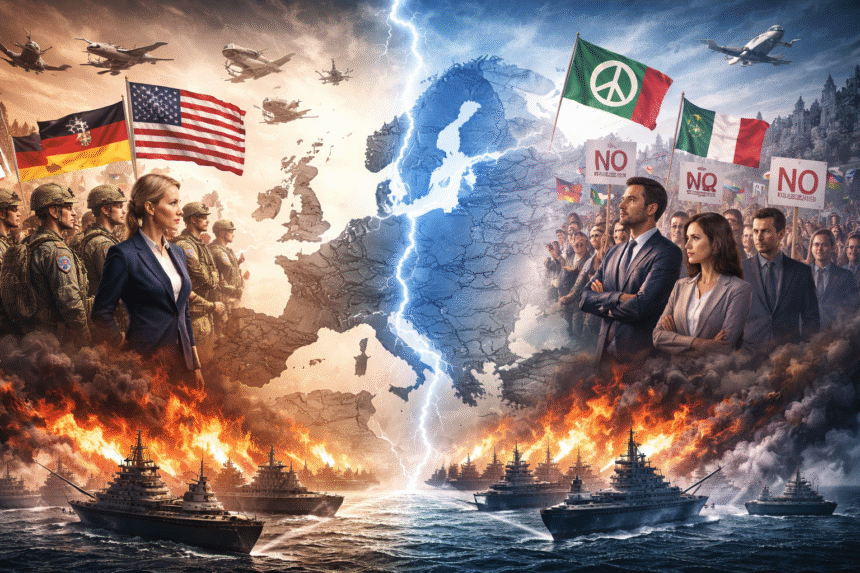
Europe is facing a deep and increasingly visible political divide over how to respond to the escalating war between the United States and Iran. What began as a distant geopolitical conflict has rapidly evolved into a defining test of Europe’s strategic unity, exposing fractures between governments, political blocs, and even public opinion across the continent.

Contents
A Fragmented Political ResponseTransatlantic Tensions ResurfaceInternal Political DivisionsEconomic Pressures Deepen the DivideStrategic Uncertainty and Limited InfluenceConclusion

A Fragmented Political Response

European leaders have not spoken with one voice. While some governments and institutions maintain cautious support for Washington, others openly reject the war and call for immediate de-escalation.

At the institutional level, European Union officials have emphasized diplomacy, urging the United States to end the conflict and pursue negotiations.
However, individual countries have taken sharply different positions. Nations like Spain have condemned the war as unilateral and destabilizing, refusing to support military operations, while others have quietly allowed logistical or defensive cooperation with U.S. forces.

This divergence highlights a broader reality: Europe remains divided on the fundamental question of military intervention and the use of force.

Transatlantic Tensions Resurface

The war has also reignited tensions between Europe and its most important ally, the United States. Washington’s decision to act with limited consultation has frustrated European capitals and reinforced calls for greater strategic independence.

Several European leaders have signaled that this is “not Europe’s war,” marking a notable shift from past conflicts where alignment with U.S. policy was more consistent.

This growing distance reflects long-standing frustrations—ranging from past unilateral U.S. decisions to broader concerns about unpredictable foreign policy—now amplified by the stakes of a major Middle Eastern conflict.

Internal Political Divisions

The divide is not only between countries—it runs within them.

Across Europe, political parties are split. Some right-wing and transatlantic factions support the U.S. position, framing the conflict as a necessary response to Iranian threats. Others, including left-wing movements and parts of the far right, oppose the war on legal, economic, or sovereignty grounds.

Public opinion mirrors this fragmentation, with protests emerging in several European cities both against and in support of the conflict.

Economic Pressures Deepen the Divide

The political split is further intensified by the war’s economic consequences. Europe is already facing rising energy prices, supply disruptions, and industrial strain linked to instability in the Middle East.

These pressures are forcing governments to prioritize national economic interests, often at the expense of a unified European stance. The result is a more fragmented policy landscape, where domestic concerns outweigh collective strategy.

Strategic Uncertainty and Limited Influence

Despite its global economic weight, Europe’s role in the conflict remains limited. The continent lacks both the military leverage and unified political will to shape the outcome decisively.

This has led to a paradox: Europe is deeply affected by the war—economically, politically, and strategically—yet struggles to influence its direction.

Conclusion

The war between the United States and Iran has exposed a critical fault line within Europe. Divided between support, opposition, and cautious neutrality, the continent is grappling with questions about its identity, autonomy, and global role.
You Might Also Like

The European Union Is Considering Reducing the Ability of Countries to Block Economic Merger Deals

Europe Has Become the Largest Importer of Weapons in the World to Confront Russia

Gas Prices Have Risen by About 65% Over a Week Due to the War and Tensions in the Strait of Hormuz

European Countries Have Strengthened Their Military Presence in the Middle East and Opened Their Bases to Support Defensive Operations

Some Countries, Like Germany, Tend to Support Washington Cautiously, While Spain and Other Countries Reject Military Escalation

World News March 23, 2026 March 23, 2026
Share This Article
Facebook Twitter Whatsapp Whatsapp Email Print
What do you think?
Love0
Sad0
Angry0
Dead0
Previous Article Europe Rejects Military Escalation in the Gulf, Urges Diplomatic Solutions
Next Article Some Countries, Like Germany, Tend to Support Washington Cautiously, While Spain and Other Countries Reject Military Escalation

Stay Connected

16k Like
85k Follow
45.6k Subscribe
Telegram Follow
- Advertisement -

Latest News

The European Union Is Considering Reducing the Ability of Countries to Block Economic Merger Deals
Europe News
Europe Has Become the Largest Importer of Weapons in the World to Confront Russia
Europe News
Gas Prices Have Risen by About 65% Over a Week Due to the War and Tensions in the Strait of Hormuz
Europe News
European Countries Have Strengthened Their Military Presence in the Middle East and Opened Their Bases to Support Defensive Operations
Europe News
Loading

Stay Informed,Europ’s Vioce Unfolded

Sign Up for Our Newsletter

Subscribe to our newsletter to get our newest articles instantly!

Loading
© 2022 Euro Post Agency. All Rights Reserved.