

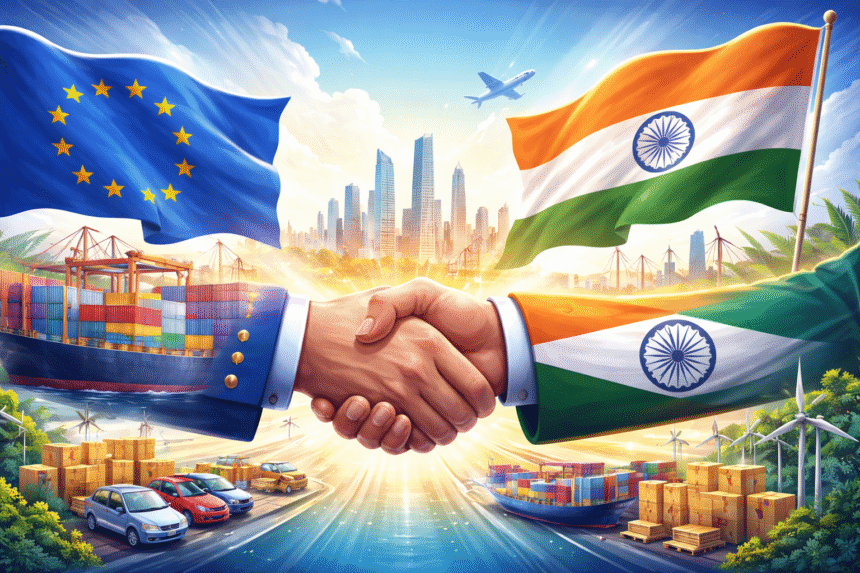
The European Union and India have signed a landmark trade agreement described by officials as one of the most significant economic deals in India’s modern history, marking a major step toward deeper strategic and commercial cooperation between the two sides.
The agreement provides for the gradual reduction of tariffs on most goods to zero, easing long-standing trade barriers that have limited market access for European and Indian exporters alike. Once fully implemented, the deal is expected to substantially boost bilateral trade volumes and strengthen supply chains linking Europe with South Asia.
A Major Boost for European Exports
For the European Union, the agreement opens one of the world’s fastest-growing consumer markets. European exporters in sectors such as automobiles, machinery, pharmaceuticals, renewable energy technology, chemicals, and luxury goods are expected to benefit from improved access to the Indian market. Reduced tariffs and clearer regulatory frameworks are likely to enhance competitiveness for European companies operating or investing in India.
EU officials have framed the agreement as a strategic response to global economic uncertainty, emphasizing the need to diversify trade partnerships and reduce reliance on a limited number of markets.
Strategic Gains for India
For India, the deal strengthens its position as a key global manufacturing and trade hub. Improved access to European markets is expected to support Indian exports in textiles, information technology services, pharmaceuticals, agriculture, and processed foods, while also attracting higher levels of foreign direct investment from Europe.
Indian policymakers have highlighted the agreement’s role in supporting domestic economic growth, job creation, and technology transfer, while integrating India more deeply into global value chains.
Beyond Trade: A Strategic Partnership
Beyond tariffs, the agreement is seen as a cornerstone of a broader EU–India strategic partnership, covering areas such as digital trade, clean energy, supply-chain resilience, and sustainable development. Both sides view the deal as a geopolitical signal, underlining closer cooperation between major democratic economies amid shifting global power dynamics.
Analysts note that the agreement also reflects growing alignment between Brussels and New Delhi on issues such as economic security, climate policy, and rules-based international trade.
Global Impact
As one of the largest trade agreements in India’s history, the deal is expected to have ripple effects across global markets. It reinforces India’s emergence as a central player in global trade while positioning the European Union as a long-term strategic economic partner in Asia.
Once fully ratified and implemented, the agreement could redefine EU–India economic relations for decades, setting a new benchmark for large-scale, strategic trade partnerships in an increasingly fragmented global economy.