

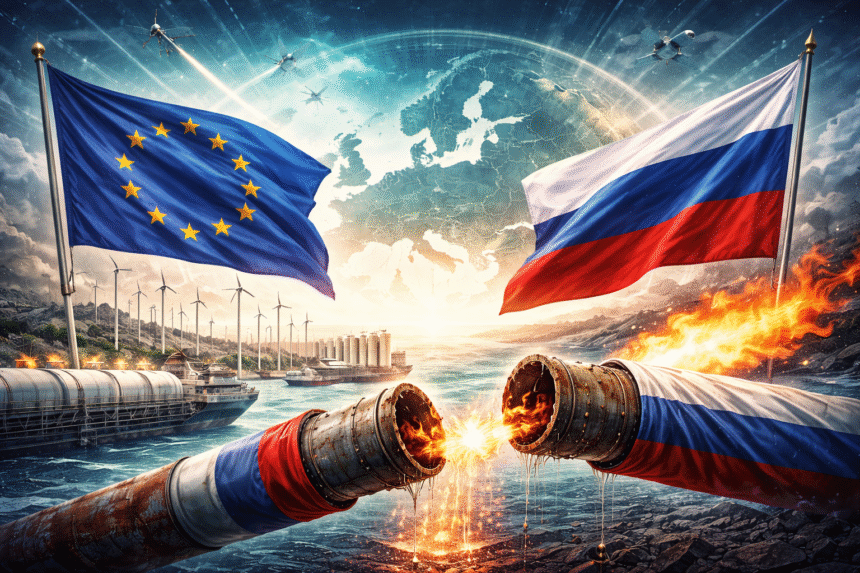
The European Union has officially approved a plan to end imports of Russian gas by the end of 2027, marking one of the most consequential strategic decisions in the bloc’s modern energy policy. The move aims to permanently reduce Europe’s dependence on Moscow and reshape the continent’s energy security in the wake of Russia’s war in Ukraine.
The decision covers both pipeline gas and liquefied natural gas (LNG), signaling a definitive break from a relationship that for decades made Russia one of Europe’s largest energy suppliers. Before the war, Russian gas accounted for roughly 40 percent of EU gas imports; today, that share has already fallen sharply, but the new approval locks in a full phase-out with a clear deadline.
European officials describe the ban as a security-driven necessity rather than a purely economic choice. They argue that energy dependence on Russia exposed the EU to political pressure, market volatility, and strategic vulnerability. By formalizing the ban, Brussels is seeking to ensure that energy can no longer be used as leverage against European states.
The plan will be implemented gradually. Short-term contracts for Russian gas will be restricted first, followed by tighter controls on long-term agreements, giving member states time to adjust supply chains, expand infrastructure, and secure alternative sources. The EU has already increased imports from Norway, the United States, and North Africa, while accelerating investments in LNG terminals, pipeline interconnections, and storage capacity.
Not all member states have welcomed the decision without reservations. Countries that were historically more reliant on Russian gas, such as Hungary and Slovakia, have warned of higher energy costs and supply risks. To address these concerns, the European Commission has emphasized solidarity mechanisms, financial support, and flexibility measures to help vulnerable economies manage the transition.
Beyond diversification, the gas ban is closely linked to Europe’s broader climate and energy agenda. The EU sees the shift as an opportunity to accelerate renewable energy deployment, energy efficiency programs, and electrification, reducing overall gas demand rather than simply replacing one supplier with another.
For Russia, the decision represents a long-term blow to one of its most lucrative export markets. While Moscow has redirected some energy exports toward Asia, analysts note that Europe’s exit from Russian gas will be difficult to fully offset, especially in the medium term.
Ultimately, the 2027 ban underscores a fundamental shift in Europe’s strategic thinking: energy is no longer viewed solely as a market commodity, but as a core element of security and foreign policy. As the deadline approaches, the success of the plan will depend on how effectively the EU balances energy affordability, supply stability, and its geopolitical goals in a rapidly changing global landscape.