

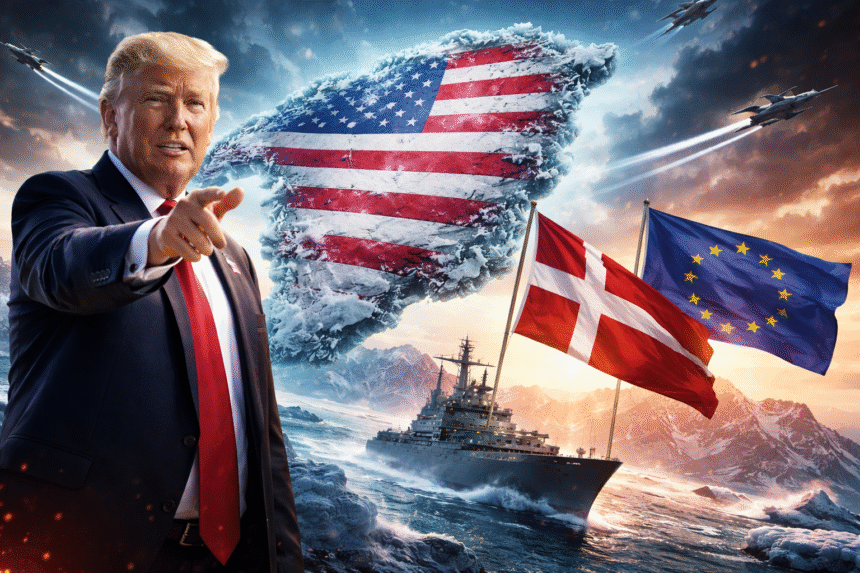
U.S. President Donald Trump has reignited controversy across Europe after insisting there would be “no retreat” from his goal of bringing Greenland under U.S. control, while refusing to rule out the use of force to achieve it. The remarks have sparked sharp reactions from European leaders, who described the statements as provocative, destabilizing, and a direct challenge to international norms.
Speaking to reporters, Trump framed Greenland as a strategic necessity for U.S. national security, citing its location in the Arctic, its growing importance amid climate change, and rising global competition over shipping routes and natural resources. “Greenland is critical,” Trump said, adding that Washington must ensure it does not fall under the influence of rival powers. His refusal to exclude military options, however, marked a significant escalation in rhetoric.
European officials responded swiftly and angrily. Denmark, which exercises sovereignty over Greenland, reaffirmed that the territory is not for sale and that its future can only be decided by the Greenlandic people themselves. Senior EU figures warned that any suggestion of using force against a European territory is unacceptable and undermines the principles of sovereignty and international law.
In Brussels, diplomats expressed concern that Trump’s comments could further strain already fragile transatlantic relations. Several EU member states called for a unified European response, arguing that the issue goes beyond Denmark and touches on the broader security architecture of Europe and the Arctic region. “This kind of language belongs to another era,” one European official said, emphasizing that disputes between allies must be handled through diplomacy, not coercion.
The controversy has also reignited debate within Greenland itself. While some local leaders have long advocated for greater autonomy or eventual independence from Denmark, there is little support for any form of external takeover. Greenland’s government reiterated that it seeks partnerships based on mutual respect, not pressure or threats.
Analysts note that Trump’s stance reflects the growing geopolitical importance of the Arctic, where melting ice is opening new trade routes and access to resources, intensifying competition among the United States, Russia, and China. However, they warn that aggressive rhetoric risks turning strategic rivalry into open confrontation, especially among NATO allies.
As reactions continue to unfold, European leaders are urging Washington to clarify its position and recommit to diplomatic engagement. For now, Trump’s remarks have added a new layer of tension to transatlantic relations, raising questions about how far the dispute could escalate — and what it means for stability in the Arctic and beyond.