

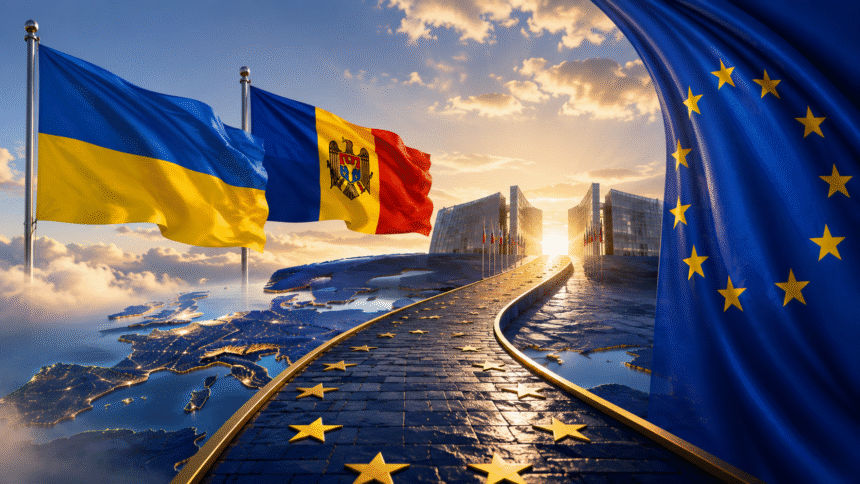
BRUSSELS — The European Union has officially launched the first phase of accession negotiations with Ukraine and Moldova, marking a historic milestone in the two countries’ long journey toward full membership in the bloc.
The move comes after years of political debate, institutional reforms, and complex discussions among EU member states regarding the future expansion of the Union. European leaders described the decision as a significant step toward strengthening stability, democracy, and economic integration across the continent.
For Ukraine, the opening of accession talks carries particular symbolic importance as the country continues to face the challenges of war and reconstruction. Kyiv has repeatedly emphasized that joining the European Union remains a strategic national objective and a key pillar of its long-term political and economic future.
Moldova has also accelerated reforms in recent years in an effort to align its institutions with European standards. Government officials in Chișinău welcomed the development, describing it as recognition of the country’s commitment to democratic governance, economic modernization, and closer ties with Europe.
European Commission officials noted that the accession process remains lengthy and demanding. Both countries will be required to implement extensive reforms across a wide range of sectors, including the judiciary, public administration, anti-corruption measures, economic governance, and the rule of law.
While the start of negotiations does not guarantee eventual membership, it represents one of the most important stages in the enlargement process. The talks are expected to be conducted chapter by chapter, with progress assessed regularly by EU institutions and member states.
Supporters of enlargement argue that integrating Ukraine and Moldova into the European Union would enhance regional security, strengthen economic cooperation, and reinforce democratic values across Eastern Europe. However, some member states have previously expressed concerns regarding the pace of expansion, budgetary implications, and the readiness of candidate countries to meet all accession requirements.
Despite these challenges, European leaders have increasingly framed enlargement as a strategic investment in the continent’s future, particularly in light of shifting geopolitical dynamics and growing security concerns along the EU’s eastern borders.
As negotiations move forward, both Ukraine and Moldova face years of reforms and technical discussions. Nevertheless, the formal opening of accession talks signals a new chapter in their relationship with the European Union and brings both nations one step closer to their goal of joining the bloc.