

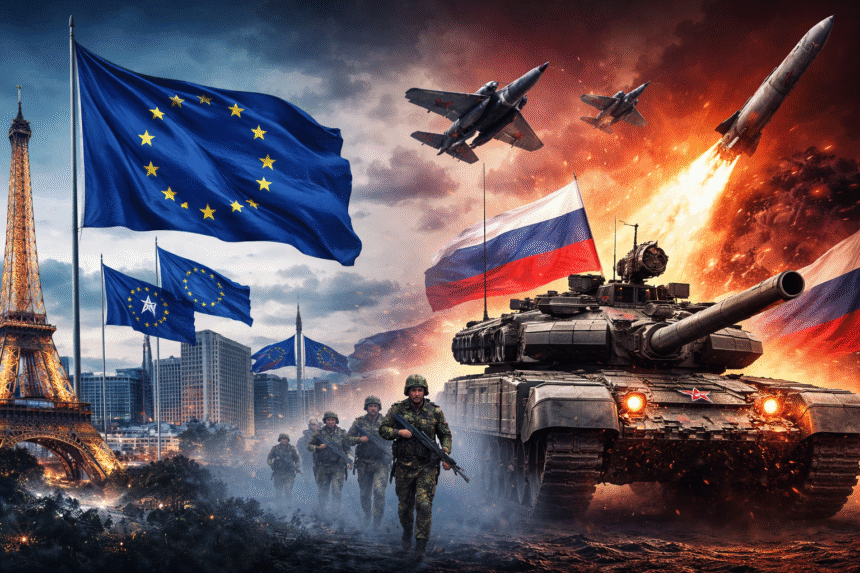
As geopolitical tensions between Russia and the West continue to intensify, policymakers and security experts in Paris are increasingly debating possible scenarios of a Russian military escalation against Europe. The discussions reflect growing unease within European Union capitals over the long-term security environment, particularly as the war in Ukraine shows no clear path toward resolution.
Strategic Anxiety in European Capitals
French defense and diplomatic circles are reassessing Europe’s vulnerability in light of Russia’s evolving military doctrine and hybrid warfare capabilities. These concerns do not necessarily point to an imminent large-scale invasion, but rather to a spectrum of risks ranging from cyberattacks and sabotage of critical infrastructure to limited military pressure on NATO’s eastern flank.
Analysts in Paris warn that Moscow could seek to test European unity by exploiting political divisions, economic fatigue, or public opposition to prolonged support for Ukraine. Such strategies would aim to weaken collective responses without triggering a full conventional confrontation.
Possible Scenarios Under Discussion
Security experts outline several potential scenarios. One involves increased pressure on Eastern European states through military drills, airspace violations, or naval maneuvers designed to intimidate and probe defenses. Another centers on hybrid actions—cyber operations, disinformation campaigns, and energy leverage—intended to destabilize European societies from within.
A more severe, though less likely, scenario would involve a localized military escalation near NATO borders, calculated to remain below the threshold of a direct alliance-wide response. French officials stress that even limited actions could have wide repercussions for European stability.
Europe’s Response and Strategic Shift
The debate in Paris underscores a broader shift in European thinking: security can no longer rely solely on external guarantees. Calls are growing for stronger defense coordination, increased military spending, and deeper intelligence sharing among EU members. France, in particular, is pushing for greater European strategic autonomy alongside continued cooperation with NATO.
While dialogue with Russia remains officially open, the tone in European capitals is increasingly cautious. The prevailing view in Paris is that preparedness and unity are essential to deter any potential escalation and to reassure European citizens in an era of prolonged uncertainty.
In this climate, the discussions taking place in France are less about predicting a single outcome and more about ensuring that Europe is ready for a range of challenges that could redefine its security landscape in the years ahead.