

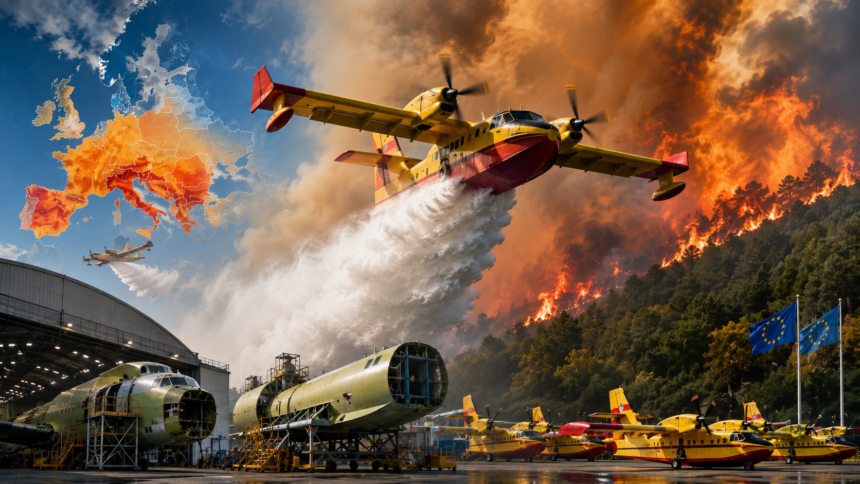
European governments and aerospace companies are accelerating efforts to develop and convert aircraft into water bombers, as increasingly destructive wildfires expose shortages in the continent’s aerial firefighting capacity.
Nearly 500,000 hectares of land have burned across Europe so far this year, with extreme heat, drought and dry vegetation creating dangerous conditions across southern and central parts of the continent. The growing scale of the fires has increased demand for aircraft capable of dropping large quantities of water or fire retardant over difficult terrain.
Several European projects are now seeking to expand the available fleet. Manufacturers are developing purpose-built firefighting aircraft while other initiatives focus on converting existing passenger or transport planes into water bombers, potentially allowing European countries to increase capacity more quickly.
The urgency is particularly significant because much of Europe currently relies on a relatively limited fleet of specialised firefighting aircraft. During severe wildfire seasons, multiple countries can require aerial support simultaneously, making it difficult to move aircraft between affected regions.
The European Union has already been expanding its rescEU firefighting fleet, which allows aircraft and helicopters stationed in member states to be deployed across borders when national resources are overwhelmed. The bloc is also investing in a permanent European aerial firefighting capability as climate change increases the frequency and severity of extreme fire conditions.
Aircraft play a crucial role in containing wildfires before they spread into populated areas. Large water bombers can release thousands of litres in a single pass, supporting firefighters on the ground and helping create barriers that slow advancing flames.
However, building specialised aircraft is expensive and can take years. Manufacturers must also meet strict aviation safety standards while ensuring that planes can repeatedly operate at low altitude, carry heavy water loads and function in extreme heat and smoke.
The challenge is becoming increasingly urgent as Europe’s traditional wildfire season expands beyond the Mediterranean. Countries farther north and east are experiencing more frequent periods of drought and extreme heat, increasing the geographical area requiring firefighting resources.
With hundreds of thousands of hectares already burned in 2026, European authorities are increasingly treating aerial firefighting capacity as a strategic climate-resilience priority rather than simply an emergency resource.
The race to expand Europe’s fleet therefore reflects a broader reality: as wildfires become larger and more frequent, the continent needs significantly more aircraft ready to respond before individual fires develop into major disasters.