

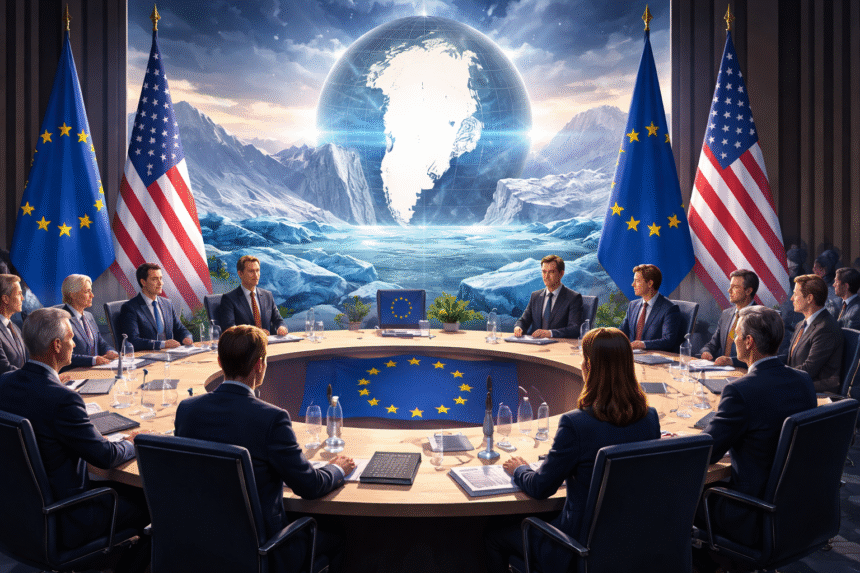
European Union leaders are convening in Brussels today for high-level talks focused on the growing strain in transatlantic relations, triggered by escalating tensions with the United States over the future of Greenland.
The meeting comes after recent American statements and reported proposals suggesting a potential agreement that would grant Washington expanded political, economic, and strategic influence over the Arctic island. These moves have raised concerns within European capitals, particularly over sovereignty, security, and the balance of power in the Arctic region.
Strategic Concerns in the Arctic
Greenland, an autonomous territory within the Kingdom of Denmark, has long been viewed as strategically vital due to its location, natural resources, and increasing importance as Arctic ice melts and new shipping routes emerge. European leaders fear that any unilateral U.S. approach could undermine European interests and weaken coordinated Western policy in the region.
Diplomatic sources indicate that several EU member states see the issue as a broader test of Europe’s ability to defend its strategic autonomy, especially at a time when geopolitical competition in the Arctic is intensifying, involving not only the United States but also Russia and China.
Transatlantic Relations Under Pressure
The Brussels talks are expected to address how the European Union should respond collectively to what officials describe as “pressure tactics” from Washington. While EU leaders remain committed to maintaining strong ties with the United States, there is growing agreement that Europe must respond firmly to any actions perceived as disregarding European partners or international norms.
Some leaders are pushing for a unified EU stance that reinforces Denmark’s position while emphasizing that decisions regarding Greenland must be made through dialogue, respect for sovereignty, and international cooperation.
Calls for European Unity
Officials familiar with the discussions say the summit will also explore longer-term questions about Europe’s role in Arctic governance, defense cooperation, and economic investment in the region. Several member states are expected to argue that the Greenland issue highlights the need for a more assertive and coordinated European foreign policy.
The outcome of the Brussels meeting could shape the tone of EU-U.S. relations in the coming months, particularly as global competition over strategic regions and resources continues to intensify.