

By using this site, you agree to the Privacy Policy and Terms of Use.
Accept
Euro Post.Euro Post.
Notification Show More
Aa
  • My Europe
    • Europe News
    • Social Issues
    • Immigration
    • EU Policies
    • EU Updates
  • World
    • Africa
    • Global Conflicts
    • Human Rights
    • Middle East
    • Latin America
    • Ukraine Crisis:
  • Business
    BusinessShow More
    Lamborghini Unleashes the Temerario: A Hybrid Supercar Poised to Surpass the Huracán
    July 26, 2025
    Is Waze Nearing the End of the Road? Google Maps Growth Raises Questions About the Future of the Navigation App
    July 26, 2025
    Germany Secures Fourth Conviction in €195 Million EU-Wide VAT Fraud Case Tied to Covid Mask Scam
    July 25, 2025
    AstraZeneca Commits $50 Billion Investment in U.S. Amid Tariff Pressures
    July 23, 2025
    ASML Shares Fall as Trump-Era Tariff Fears Cloud 2026 Growth Outlook
    July 17, 2025
  • Sport
  • Travel
  • Culture
    • Art/Design
    • Literature
    • Music
    • Film – TV
    • Fashion
Reading: EU Phased Plan to End Russian Gas Imports Faces Resistance from Hungary and Slovakia
Share
Aa
Euro Post.Euro Post.
  • My Europe
  • World
  • Business
  • Sport
  • Travel
  • Culture
Search
  • My Europe
    • Europe News
    • Social Issues
    • Immigration
    • EU Policies
    • EU Updates
  • World
    • Africa
    • Global Conflicts
    • Human Rights
    • Middle East
    • Latin America
    • Ukraine Crisis:
  • Business
  • Sport
  • Travel
  • Culture
    • Art/Design
    • Literature
    • Music
    • Film – TV
    • Fashion
Follow US
  • Advertise
© 2021 Euro Post Agency.com. All Rights Reserved.
Euro Post. > Blog > My Europe > EU Updates > EU Phased Plan to End Russian Gas Imports Faces Resistance from Hungary and Slovakia
EU Updates

EU Phased Plan to End Russian Gas Imports Faces Resistance from Hungary and Slovakia

World News
By World News Published January 26, 2026
Share

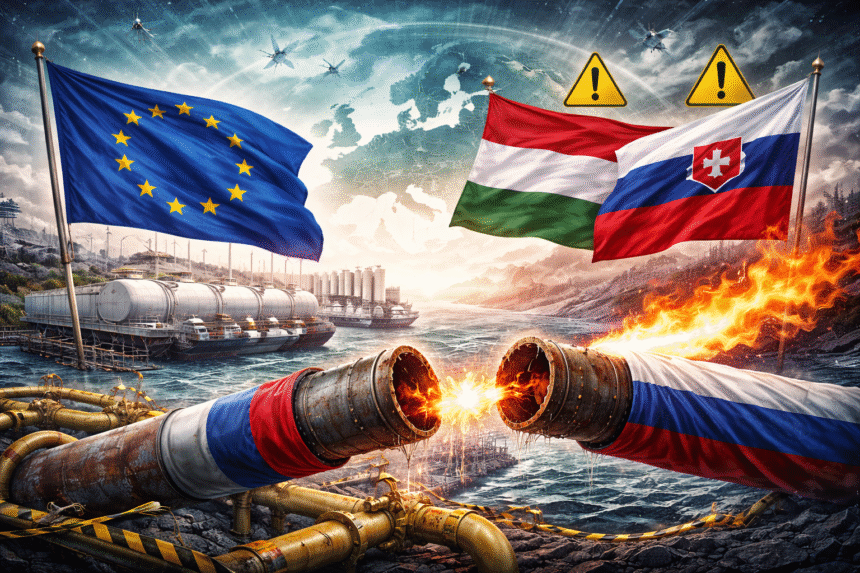
The European Union is moving forward with a phased plan to implement its ban on Russian gas imports, beginning with liquefied natural gas (LNG) and later extending to pipeline supplies. While EU officials describe the approach as pragmatic and necessary for energy security, the strategy has sparked objections from several member states, most notably Hungary and Slovakia, which remain heavily dependent on Russian gas flows.

Under the proposed implementation, imports of Russian LNG would be curtailed first, targeting spot purchases and short-term contracts. This initial phase is designed to limit Russia’s flexibility in redirecting shipments while allowing EU states time to secure alternative LNG supplies from the United States, Qatar, and other producers. Pipeline gas — traditionally the backbone of Russian exports to Europe — would be phased out at a later stage, giving landlocked and highly exposed countries more time to adapt.

European policymakers argue that the sequencing is essential to avoid sudden market shocks. LNG imports are considered easier to replace due to the global nature of the LNG market and the expansion of European regasification terminals since 2022. Pipeline gas, by contrast, involves long-term infrastructure constraints and limited routing options, particularly for Central and Eastern European states.

Hungary and Slovakia have emerged as the most vocal critics of the plan. Both governments warn that cutting off Russian pipeline gas could raise energy prices, threaten industrial competitiveness, and undermine national energy security. Officials in Budapest and Bratislava have repeatedly called for exemptions or extended transition periods, arguing that alternatives remain insufficient or too costly in the short term.

The European Commission has responded by emphasizing solidarity mechanisms and flexibility. Brussels has proposed financial support, joint gas purchasing, and infrastructure investments — including interconnectors and reverse-flow pipelines — to help affected countries reduce their reliance on Russian supplies. EU officials stress that the objective is not to punish individual member states, but to ensure that no country remains strategically vulnerable to external pressure.

Beyond internal disagreements, the phased ban reflects a broader shift in how the EU views energy policy. Gas is no longer treated purely as a commercial commodity, but as a strategic asset closely linked to foreign policy and security. By first targeting LNG and later pipeline gas, the EU aims to steadily dismantle Russia’s role in its energy system while maintaining stability during the transition.

As negotiations continue, the debate highlights the challenge facing the EU: balancing unity and security goals with the economic realities of member states that remain structurally tied to Russian energy. Whether the phased approach can maintain consensus will be a key test of Europe’s ability to act collectively in an increasingly fragmented geopolitical environment.


You Might Also Like

EU Council President: Russia Is the “Only Winner” from the Current War

European Union countries are facing divisions over how to deal with the war linked to Iran

European Union Holds Emergency Meetings to Address Middle East Crisis and Coordinate Gas Supplies

Iran Threatens Military Response to European Countries if They Participate in War — A Major Escalation Raises Alarm in Brussels

Rising Beer Prices in EU Countries Put Pressure on Pubs and Consumers

World News January 26, 2026 January 26, 2026
Share This Article
Facebook Twitter Whatsapp Whatsapp Email Print
What do you think?
Love0
Sad0
Angry0
Dead0
Previous Article European Union Approves Ban on Russian Gas Imports by 2027 in Strategic Energy Shift
Next Article UK Prime Minister Keir Starmer Begins High-Stakes Tour of China and Japan

Stay Connected

16k Like
85k Follow
45.6k Subscribe
Telegram Follow
- Advertisement -

Latest News

Officials Warn European Economy Facing Tough Test Amid Current Crisis
Europe News
Hungarian Prime Minister Urges EU to Lift Sanctions on Russian Energy Amid Rising Prices
Europe News
Middle East War and Oil Supply Disruptions Put Severe Pressure on European Economy
Europe News
EU Leaders Discuss Urgent Measures to Reduce Energy Prices
Europe News
Loading

Stay Informed,Europ’s Vioce Unfolded

Sign Up for Our Newsletter

Subscribe to our newsletter to get our newest articles instantly!

Loading
© 2022 Euro Post Agency. All Rights Reserved.