


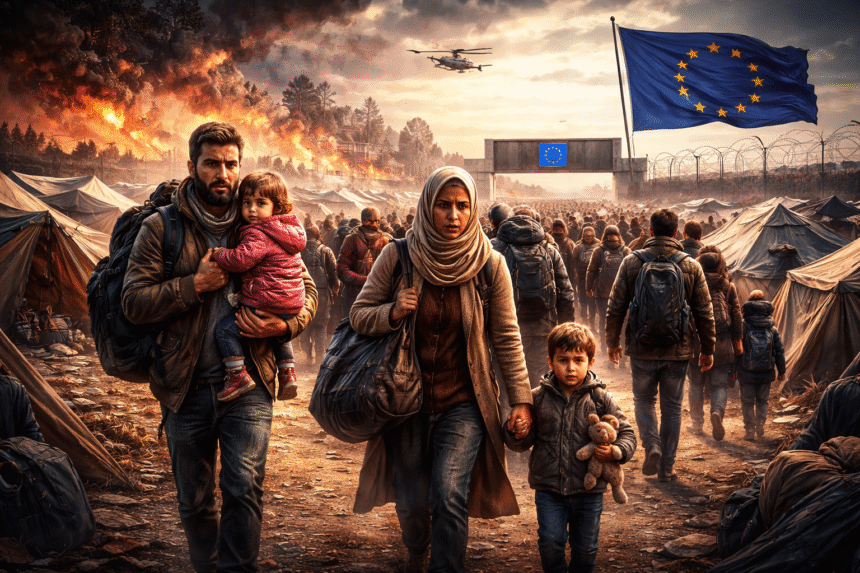
European Union leaders are warning of a potential new wave of refugees as escalating conflicts in the Middle East threaten to displace millions, raising fresh concerns about migration pressures across the continent.
The renewed instability in the region, driven by ongoing military confrontations and rising geopolitical tensions, is already forcing civilians to flee their homes. European officials fear that if the situation deteriorates further, migration routes toward Europe could see a significant surge in the coming months.
Senior EU policymakers have begun drafting emergency response plans aimed at managing a potential influx of refugees. These measures include expanding reception capacities, strengthening border coordination, and enhancing cooperation with frontline states that are likely to receive the largest number of arrivals.
Countries in Southern Europe—particularly those along the Mediterranean—are expected to bear the initial impact. Nations such as Greece, Italy, and Spain are already reviewing contingency strategies to avoid a repeat of the migration crises seen in previous years.
European leaders have stressed the importance of a coordinated approach to prevent divisions within the bloc. Past migration waves exposed deep political disagreements among member states, particularly over burden-sharing and relocation policies. This time, officials say, there is a stronger emphasis on unity and preparedness.
At the same time, humanitarian concerns remain central to the EU’s response. Authorities are working to ensure that asylum procedures remain in line with international law, while also addressing the immediate needs of displaced populations, including shelter, healthcare, and basic services.
Beyond internal preparations, the EU is also engaging with neighboring countries and international organizations to manage migration flows closer to the regions of origin. Increased funding and logistical support are being considered to help stabilize affected areas and reduce the pressure on European borders.
Analysts warn that the scale of displacement will largely depend on how the conflicts evolve. A prolonged or intensified war could trigger mass movements not only within the Middle East but also toward Europe, adding strain to already stretched resources.
For European governments, the challenge lies in balancing security, political stability, and humanitarian responsibility. As tensions continue to rise, the prospect of a new refugee crisis is no longer a distant possibility—but an imminent test of Europe’s preparedness and unity.