


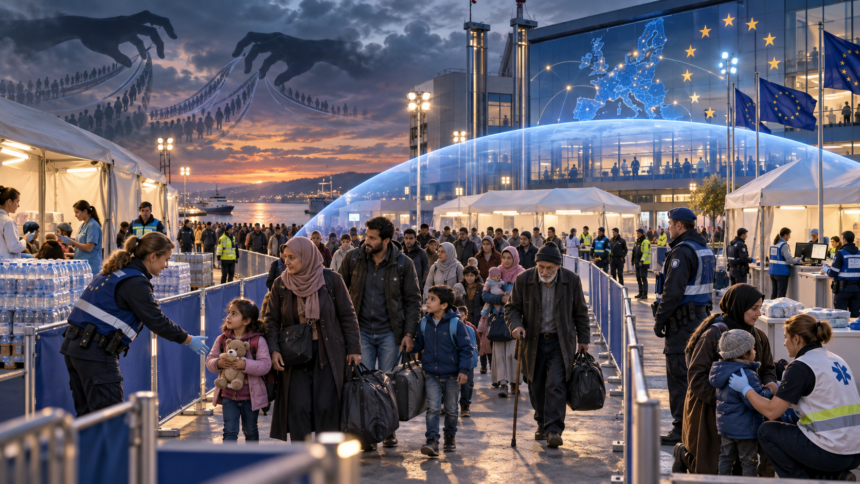
The European Commission is proposing a new emergency framework that would allow the European Union to respond collectively to sudden, large-scale migration flows, particularly when they are believed to have been deliberately organised or exploited to exert political pressure.
The proposed European Emergency Response Framework would give EU institutions and member states greater flexibility to act when existing asylum and border procedures are overwhelmed by exceptional circumstances.
European Commission President Ursula von der Leyen said the mechanism would be intended for strictly defined situations involving the “engineered and weaponised” movement of migrants. European officials have increasingly expressed concern that foreign governments or other actors could facilitate migration towards the bloc’s external borders to destabilise individual countries or pressure the EU politically.
Under the proposal, an affected member state could request the activation of coordinated European measures. These could include additional border personnel, emergency financial assistance, accelerated logistical support and the redistribution of responsibilities among EU countries.
Authorities might also be permitted to adjust certain administrative procedures temporarily, including registration arrangements and processing deadlines, when the number of arrivals exceeds the capacity of the affected country. Any exemptions would be limited in duration and subject to specific conditions.
The Commission maintains that the framework would preserve fundamental rights and Europe’s international protection obligations. Individuals seeking asylum would retain the right to have their claims assessed, while restrictions on collective expulsions and protections for vulnerable people would continue to apply.
Special consideration would be required for unaccompanied children, families, victims of trafficking and people needing urgent medical care. The Commission is also expected to propose monitoring mechanisms to ensure that emergency powers are not used beyond their intended purpose.
The initiative reflects lessons learned from previous crises at Europe’s external borders, where large groups of migrants were directed towards neighbouring EU states during periods of political tension. Such incidents exposed divisions between member states over responsibility, border control and the treatment of asylum seekers.
Supporters argue that Europe needs a rapid-response mechanism because conventional asylum procedures were designed to manage ordinary migration patterns rather than sudden movements involving tens of thousands of people. They say the absence of a unified framework can leave frontline countries isolated and encourage inconsistent national responses.
Human-rights organisations are likely to examine the proposal closely. They have previously warned that broad emergency powers could weaken access to asylum, increase detention and result in migrants being returned without adequate individual assessments.
The Commission will therefore face the challenge of distinguishing between legitimate migration movements and flows that have been deliberately manipulated for geopolitical purposes. Establishing clear evidence of political coordination may prove difficult, especially during rapidly developing border emergencies.
The framework would complement the EU’s wider migration and asylum rules rather than replace them. It must still be developed in detail and approved through the European legislative process before it can take effect.
If adopted, the mechanism would mark a significant expansion of Europe’s collective crisis-management capabilities, while testing whether the bloc can strengthen its borders without compromising the fundamental rights at the heart of its legal system.