


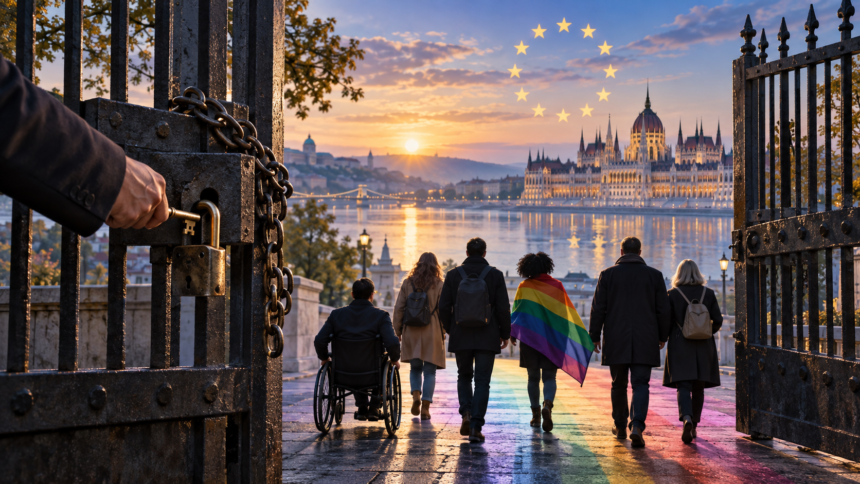
Hungary’s new government has submitted legislation to Parliament that would remove restrictions on LGBTQ+ content introduced during Viktor Orbán’s 16 years in power, marking a significant shift in the country’s social and political direction.
The bill, presented by Prime Minister Péter Magyar’s administration, would repeal rules prohibiting the “display and promotion of homosexuality” and gender change in media content accessible to people under 18.
Orbán’s government introduced the restrictions in 2021 as part of legislation it described as necessary to protect children. However, human-rights organisations and European institutions argued that the law wrongly associated LGBTQ+ representation with material harmful to minors.
The legislation affected television programmes, advertising, educational materials and other forms of public communication. Critics said its broad language encouraged censorship and contributed to the exclusion and stigmatisation of gay and transgender people.
In April, the European Union’s highest court ruled that the restrictions violated EU law and contributed to the marginalisation of LGBTQ+ citizens. Hungary’s new Justice Minister, Márta Görög, subsequently acknowledged that the country would need to revise its legislation.
Under the government’s proposed replacement, restrictions would focus on material capable of seriously harming a child’s physical, intellectual, emotional or moral development. The bill identifies pornography, sexual exploitation, abuse, grooming and age-inappropriate sexual content as the principal threats requiring regulation.
The government argues that this approach would protect minors from genuinely harmful material without automatically treating LGBTQ+ identities or relationships as inappropriate.
Prime Minister Magyar has also indicated that his administration intends to revise rules that effectively prevented same-sex couples from adopting children. Any such change is likely to provoke further political and public debate in a country where conservative social policies became a defining feature of the previous government.
The reform is part of Magyar’s broader effort to return Hungary to the European Union’s political mainstream. Relations between Budapest and Brussels deteriorated under Orbán because of disputes concerning judicial independence, media freedom, minority rights, corruption and the rule of law.
Those disputes led the EU to freeze billions of euros in funding allocated to Hungary. The new government hopes that addressing European concerns will rebuild confidence and help restore access to suspended funds.
Nevertheless, reversing Orbán-era policies may prove complicated. Conservative groups are expected to oppose the changes, while human-rights organisations will closely examine whether the new legislation genuinely removes discriminatory restrictions.
The bill represents one of the clearest indications that Hungary’s new leadership intends to pursue a different relationship with both domestic minority groups and the European Union. Its passage would mark a major departure from the socially conservative agenda that shaped Hungarian politics for more than a decade.