Serbia has turned to Russia for aerial firefighting assistance as a major wildfire continues to burn in the country, highlighting the pressure extreme summer conditions are placing on emergency services across Europe.
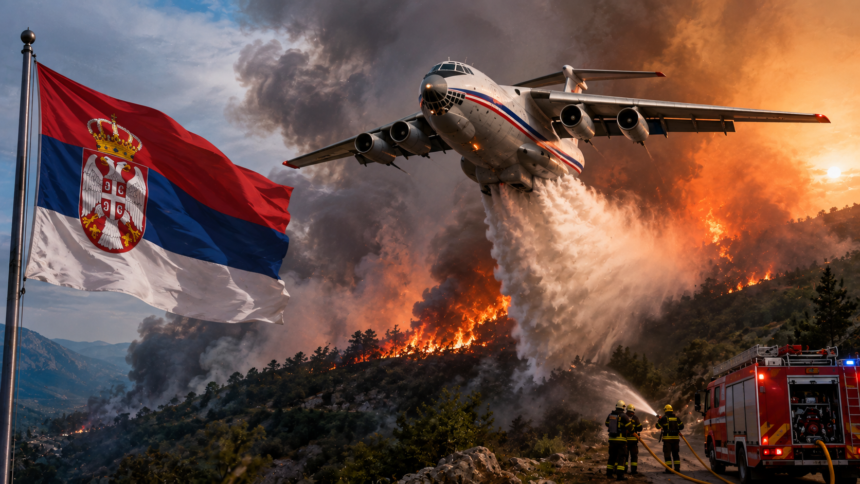
A Russian Ilyushin Il-76P firefighting aircraft from Russia’s Emergencies Ministry arrived in the southern Serbian city of Niš on August 19 and began operations the following day. The aircraft was deployed against a prolonged wildfire in the Deliblatska Peščara protected nature reserve, roughly 60 kilometres east of Belgrade.
Serbia’s Interior Ministry said it sought Russian assistance because suitable firefighting aircraft from the European Union were not immediately available. The decision came as European countries contend with multiple fires and severe summer conditions that have stretched aerial firefighting capacity across the continent.
Russian Water Bomber Joins the Battle
The Il-76P gives Serbian firefighters substantial additional aerial capacity as crews attempt to contain the fire across the Deliblatska Peščara reserve. The blaze has been burning through large areas of the protected landscape for weeks, with evacuations reported as authorities work to prevent further spread.
The Russian aircraft’s journey also carried unusual geopolitical significance. It travelled through the airspace of Bulgaria, an EU and NATO member, despite restrictions imposed on Russian aircraft following Moscow’s invasion of Ukraine. The flight was permitted under a humanitarian exemption for the firefighting mission.
Why Serbia Asked Moscow
Although Serbia is not an EU member, it participates in the EU Civil Protection Mechanism, which can coordinate international assistance during major natural disasters and emergencies.
The European Commission said Serbia had not activated the mechanism for this particular fire and stressed that European assistance remained available depending on Serbia’s requirements. Serbian authorities, however, said there were no comparable EU aircraft immediately available, leading Belgrade to seek Russian support.
The episode comes against the backdrop of Serbia’s complicated geopolitical position. Belgrade is pursuing membership of the European Union while maintaining historically close political and cultural relations with Moscow. Serbia has also declined to join EU sanctions against Russia over the war in Ukraine.
A Difficult Wildfire Season Across Europe
Serbia’s emergency is part of a much broader wildfire crisis affecting Europe during the summer of 2026. Fires have struck countries across southern and western Europe, while prolonged heat and dry vegetation have created dangerous conditions for new outbreaks.
England and Wales have recorded unprecedented levels of wildfire activity, while Germany recently battled its largest recorded wildfire in North Rhine-Westphalia. Greece, Spain and France have also faced destructive fires during the summer.
Scientists have warned that climate change is increasing the likelihood of some of the extreme weather conditions that fuel major wildfires. Recent research found that human-caused climate change made fire-prone conditions substantially more likely in parts of France and Spain this summer.
For Serbia, the immediate priority remains containing the Deliblatska Peščara fire. But the arrival of a Russian firefighting aircraft also illustrates a wider European challenge: as simultaneous climate emergencies stretch national and regional resources, governments may increasingly have to look beyond their usual partners for rapid emergency assistance.