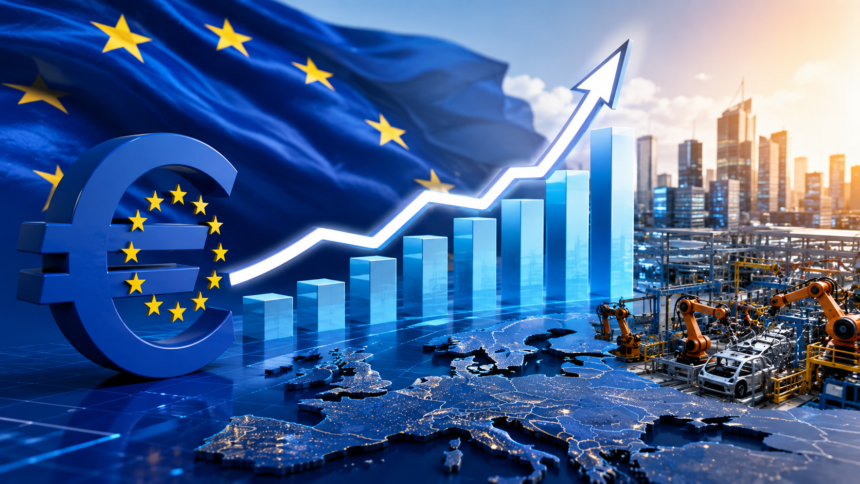
The eurozone economy showed fresh signs of resilience in August, with business activity expanding at its fastest pace since November as manufacturing strengthened, new orders accelerated and exports returned to growth.
Preliminary data from S&P Global showed the Flash Eurozone Composite PMI Output Index rose to 52.1 in August, up slightly from 52.0 in July and above the 51.7 forecast in a Reuters poll. A PMI reading above 50 indicates expansion, while anything below 50 signals contraction.
The figures suggest the 21-country currency bloc is maintaining economic momentum despite geopolitical uncertainty, elevated energy prices and higher borrowing costs. The eurozone economy had already expanded by 0.4% in the second quarter, and the latest surveys point toward continued growth during the third quarter.
Manufacturing Leads the Improvement
The strongest signal came from Europe’s factories. The eurozone manufacturing PMI climbed to 52.8 in August from 51.9 in July, reaching its highest level in more than four years. Manufacturing output, meanwhile, recorded its strongest growth in 54 months.
Demand also improved significantly. New orders across the private sector increased at their fastest rate in 40 months, suggesting companies are receiving stronger underlying demand rather than simply working through existing backlogs.
Perhaps more significantly for Europe’s trade-dependent economy, export orders increased for the first time since Russia’s full-scale invasion of Ukraine in February 2022.
The services sector remained comparatively stable, with its PMI holding at 51.7, still comfortably above the threshold separating expansion from contraction.
Germany’s Factories Stage a Strong Recovery
Europe’s largest economy provided another encouraging signal. Germany’s manufacturing PMI jumped from 52.2 in July to 54.1 in August — its strongest reading in 51 months.
Germany’s overall composite PMI remained in expansion territory at 51.0, although weakness in services continued to restrain growth. The German services PMI dropped to 48.5, indicating contraction.
France presented a weaker picture, with economic activity contracting more than expected as recent heatwaves weighed particularly heavily on its large services sector.
Jobs and Inflation Offer Mixed Signals
There was also positive news for employment. Eurozone companies increased staffing levels for the first time in 2026, with manufacturers returning to hiring after more than three years and services employment recording its strongest growth in eight months.
At the same time, some inflationary pressures eased. Growth in companies’ input costs slowed to a six-month low, while output-price inflation fell to its weakest level in five months.
However, inflation remains an important challenge. Eurozone inflation stood at 2.9% in July, still above the European Central Bank’s 2% target, and economists surveyed by Reuters expect the ECB to raise interest rates again in September.
Positive Momentum, but Risks Remain
The August PMI figures offer one of the clearest indications this year that Europe’s industrial recovery is gaining traction. Stronger manufacturing, accelerating orders, renewed exports and improving employment all point toward greater resilience in the eurozone economy.
Yet businesses remain cautious about what comes next. Confidence regarding the year ahead remains below its historical average as companies confront elevated energy costs, geopolitical instability and the possibility of tighter monetary policy.
For now, however, the August figures provide an encouraging signal: the eurozone economy is expanding, manufacturing is accelerating, and demand is strengthening despite a difficult global environment.