


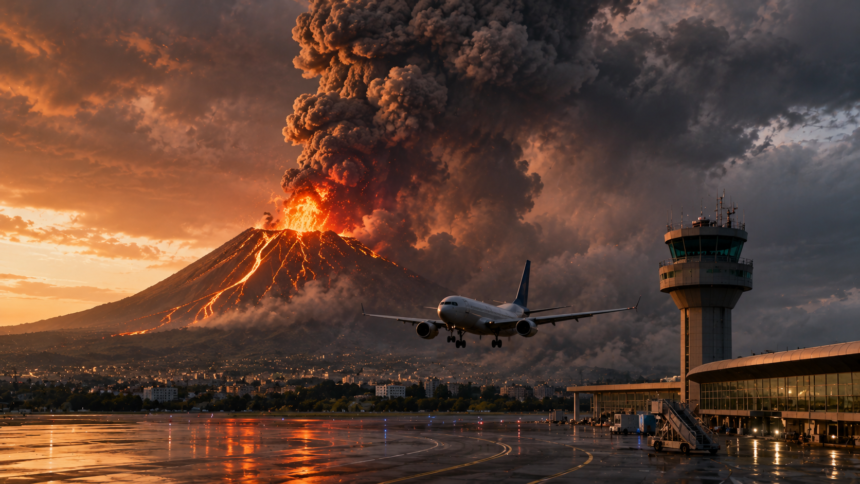
A fresh eruption of Mount Etna has disrupted air travel in Sicily, forcing authorities to suspend incoming flights at Catania Airport after volcanic ash spread into the airspace surrounding one of Italy’s busiest aviation hubs.
Airport operator SAC suspended all arrivals at Catania on Monday, August 10, until 5 p.m. local time as ash from Europe’s largest active volcano created potentially dangerous conditions for aircraft. Passengers were advised to check their flight status before travelling to the airport as authorities continued monitoring the situation.
The disruption comes during the peak summer tourism season, when Sicily attracts large numbers of domestic and international visitors. Catania Airport is the main aviation gateway to eastern Sicily and Italy’s fifth-busiest airport by passenger traffic, making even temporary restrictions capable of affecting thousands of travelers.
Italy’s National Institute of Geophysics and Volcanology reported continued eruptive activity at Mount Etna, with ash emissions accompanied by lava flows from vents at elevations of approximately 2,750 and 2,360 meters.
The aviation warning for Etna remained at the highest “red” level as scientists monitored volcanic activity and the movement of the ash cloud. Volcanic ash poses a particular danger to aviation because particles can reduce visibility and potentially damage aircraft engines.
The latest disruption follows several days of problems at Catania Airport linked to Etna’s activity. Arrivals have faced repeated suspensions and some flights have been diverted, including to Palermo, as changing winds carried volcanic material toward the airport and surrounding airspace.
Mount Etna, which dominates Sicily’s eastern landscape, is among the world’s most active volcanoes. Its proximity to Catania means eruptions frequently create challenges for aviation even when lava flows pose no direct threat to populated areas.
The timing of the latest eruption is particularly difficult for Sicily’s tourism industry. August is one of the busiest periods of the year for the Mediterranean island, and interruptions at Catania can quickly produce delays, diversions and cancellations across airline networks serving destinations throughout Europe.
Authorities continue to monitor both volcanic activity and weather conditions, particularly wind direction, which determines where Etna’s ash plume travels.
For travelers, the situation remains dependent on conditions around the volcano. Airport authorities have urged passengers to verify flight information directly with their airlines before heading to Catania as Sicily once again confronts the challenge of keeping one of its busiest transport hubs operating beneath one of Europe’s most active volcanoes.