


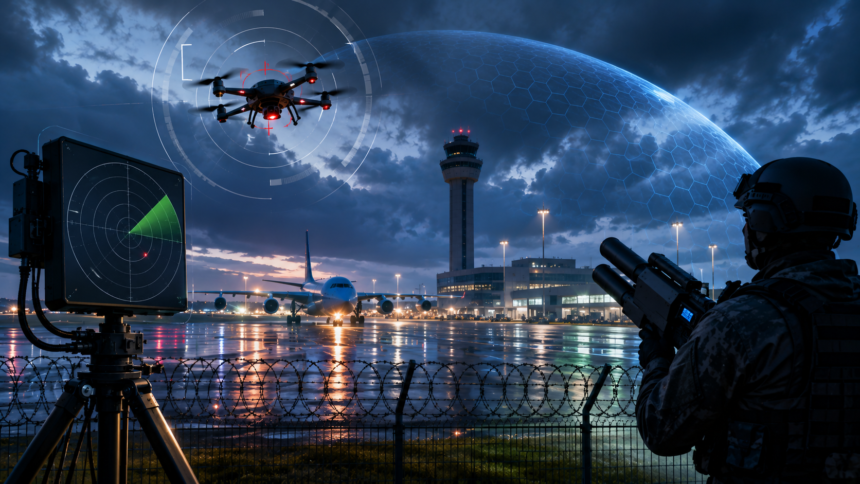
Germany is facing renewed pressure to strengthen its defenses against hostile drones after authorities discovered an unmanned aircraft equipped with professional explosives and a detonator at Leipzig/Halle Airport, one of Europe’s most important air-cargo hubs.
The drone was discovered in a secured area of the airport near the southern runway during the night of August 4–5. German specialists subsequently secured the device and removed its detonator. The incident temporarily disrupted operations at the airport and prompted authorities to open a counterterrorism investigation.
Germany’s Federal Prosecutor General has since taken over the investigation because of the seriousness of the incident. Prosecutors are investigating suspected attempted detonation of explosives as well as dangerous interference with air traffic, while authorities work to determine who was responsible and what the intended target may have been.
The investigation has become even more significant following indications that another drone may have been involved. According to Reuters, investigators are examining whether a second unmanned aircraft collided with or came dangerously close to a cargo plane that was forced to abort its landing approach.
Leipzig/Halle is particularly sensitive because it is one of Europe’s largest cargo airports and a major logistics hub. The airport also handles operations connected to Ukrainian cargo carrier Antonov Airlines, adding to concerns about the potential security implications of the incident.
The discovery has intensified Germany’s wider debate over whether police and security agencies have sufficient technology and legal authority to detect, track and neutralize suspicious drones before they reach airports, military facilities or other critical infrastructure.
The incident also comes against the backdrop of previous suspected sabotage operations targeting European logistics networks. European investigators have previously linked a series of incendiary parcels sent through logistics companies in 2024 to suspected Russian military intelligence operations, including a parcel that caught fire at Leipzig airport. Moscow has denied accusations that it conducts sabotage operations against countries supporting Ukraine.
Russia has also rejected suggestions of Russian involvement in the latest Leipzig/Halle incident, describing the allegations surrounding the drone as a fabricated provocation. German investigators have not publicly established who was responsible for the explosive-equipped aircraft.
For German authorities, the incident underscores an emerging security challenge: relatively small unmanned aircraft can potentially threaten airports and other strategic facilities while being difficult to detect and intercept quickly.
As the investigation continues, the Leipzig/Halle case is likely to accelerate Germany’s efforts to expand anti-drone detection and interception capabilities and strengthen protection around airports and other critical infrastructure.