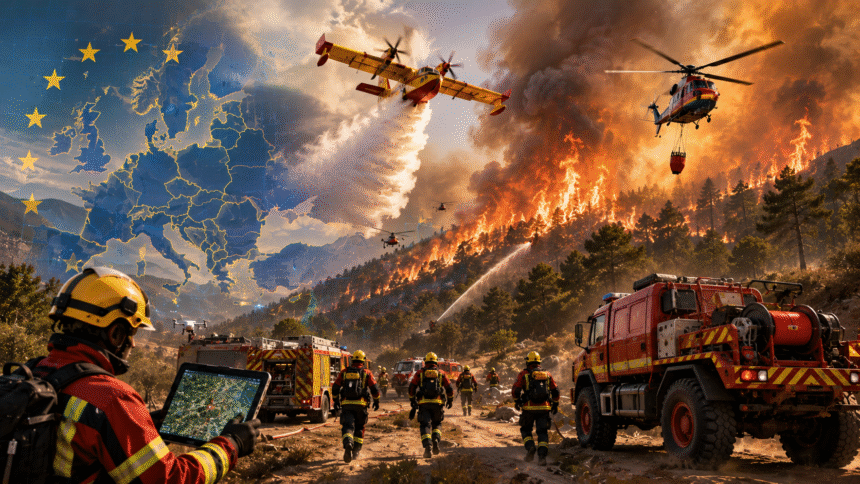
The European Commission has announced the deployment of a record number of firefighters, emergency teams, and specialized aircraft in preparation for what is expected to be one of the most dangerous wildfire seasons in recent years.
European officials warned that rising temperatures, prolonged droughts, and increasingly severe heatwaves across the continent have significantly increased the risk of large-scale forest fires during the summer of 2026.
As part of the emergency preparations, the European Union is expanding its coordinated firefighting capabilities through the EU Civil Protection Mechanism. Thousands of firefighters from multiple member states are expected to be placed on standby, alongside water-dropping aircraft, helicopters, surveillance drones, and rapid-response emergency units.
Countries in Southern Europe, including Spain, Greece, Italy, Portugal, and parts of France, are considered among the most vulnerable regions due to dry vegetation, strong winds, and extreme summer temperatures. Officials also warned that wildfire risks are no longer limited to Mediterranean regions, as climate conditions continue affecting wider parts of Europe.
The European Commission stated that the continent has witnessed a sharp increase in extreme weather events over recent years, with heatwaves becoming longer and more intense. Scientists and environmental experts link the worsening wildfire seasons to climate change and rising global temperatures.
Authorities across Europe are already carrying out preventive measures, including forest monitoring, controlled vegetation clearing, public awareness campaigns, and strengthening emergency evacuation systems in high-risk areas.
The expansion of firefighting resources comes after several devastating wildfire seasons in recent years caused massive environmental destruction, forced evacuations, damaged infrastructure, and significant economic losses across multiple European countries.
European officials emphasized the importance of cross-border cooperation, noting that wildfire emergencies increasingly require rapid coordination between neighboring countries due to the scale and speed at which fires can spread during extreme weather conditions.
In addition to emergency response measures, European institutions continue discussing long-term environmental strategies focused on climate adaptation, forest management, water conservation, and reducing carbon emissions.
Analysts say Europe’s growing investment in wildfire preparedness reflects broader concerns about the long-term impact of climate change on public safety, agriculture, tourism, and energy infrastructure throughout the continent.
Meteorological agencies have already warned that temperatures during parts of the summer could exceed seasonal averages in several European regions, increasing fears that 2026 could become another record-breaking year for wildfires and extreme weather events.
As Europe enters the summer season, governments and emergency services remain on high alert, preparing for what officials describe as a critical test of the continent’s disaster response capabilities.