

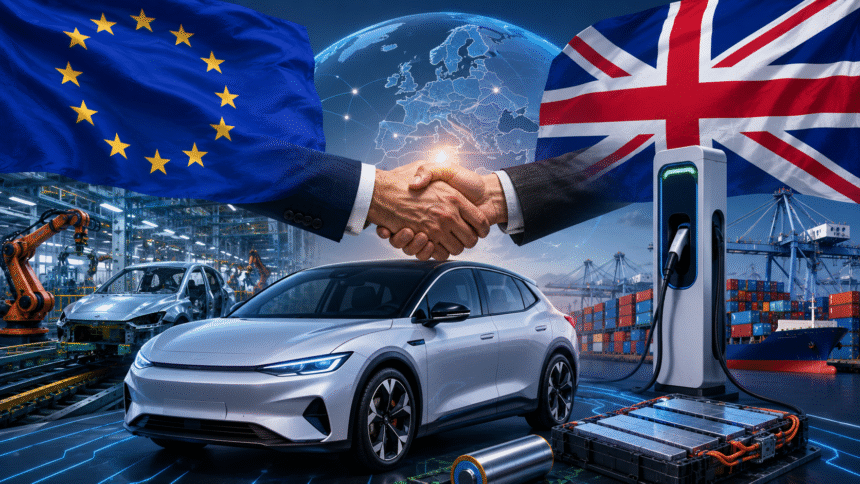
The European Union and the United Kingdom are holding discussions over delaying the implementation of new customs duties on electric vehicles, amid mounting pressure from European and British car manufacturers concerned about the competitiveness of the industry after Brexit.
Automakers on both sides are urging policymakers to postpone the tariffs, warning that European supply chains remain insufficiently prepared to compete with China’s rapidly expanding dominance in the electric vehicle battery sector.
Under post-Brexit trade arrangements, stricter customs rules on electric vehicles and battery components are expected to come into effect, potentially increasing costs for manufacturers and consumers alike. Industry leaders argue that the timing could damage Europe’s automotive sector during a critical transition toward electric mobility.
European and British manufacturers remain heavily dependent on imported battery materials and components, particularly from Asian suppliers. Companies warn that imposing additional tariffs before local battery production networks are fully developed could disrupt manufacturing operations, reduce investment, and weaken the competitiveness of European-made electric vehicles.
The issue has become increasingly sensitive as Chinese electric vehicle manufacturers continue expanding their presence in global markets with lower production costs and advanced battery supply chains. European officials fear that the continent risks falling behind in the race for electric vehicle leadership if industrial policies and supply infrastructure are not strengthened quickly.
Industry groups say delaying the tariffs would provide manufacturers with more time to localize battery production, secure raw materials, and adapt supply chains within Europe and the United Kingdom. Several major carmakers have reportedly warned governments that immediate tariff implementation could lead to reduced production and potential job losses across the sector.
The discussions also reflect broader efforts by London and Brussels to stabilize economic relations after years of Brexit-related tensions. While political disagreements remain on several issues, both sides recognize the strategic importance of protecting the automotive industry, one of Europe’s largest manufacturing sectors.
Analysts say the electric vehicle transition has become a major industrial and geopolitical challenge for Europe. Competition with China, rising energy costs, and global trade uncertainty continue to place pressure on European manufacturers already facing slowing economic growth.
At the same time, environmental goals across Europe continue pushing governments toward accelerating the shift away from gasoline-powered vehicles. Policymakers are now attempting to balance climate targets with industrial competitiveness and economic stability.
Observers believe a temporary delay in tariffs is increasingly likely as negotiations continue between the European Union and the United Kingdom. However, long-term concerns remain over whether Europe can build a fully competitive electric vehicle ecosystem capable of reducing dependence on foreign battery suppliers.
The outcome of the talks could have significant implications for the future of Europe’s automotive industry, trade relations after Brexit, and the continent’s position in the rapidly evolving global electric vehicle market.