

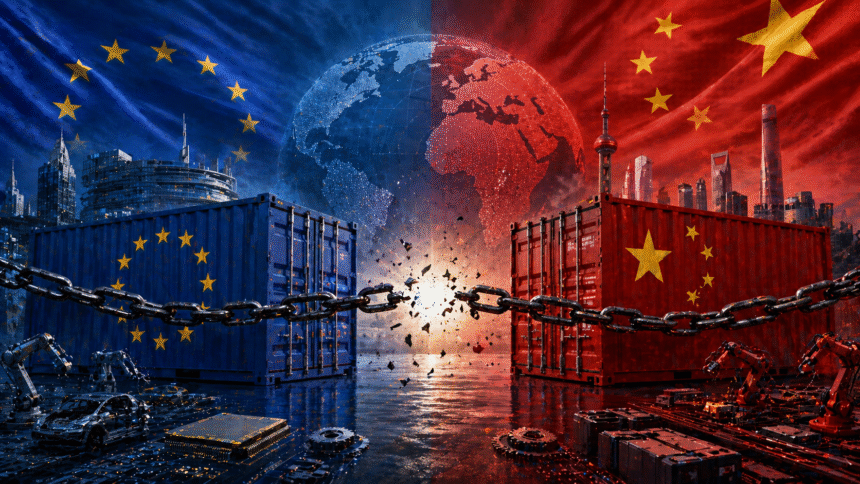
A new trade dispute is emerging between China and the European Union after Beijing sharply criticized Brussels’ plan to strengthen local industry under a “Made in Europe” approach. The proposal is designed to support European companies in strategic sectors, but China argues that it could create discriminatory barriers against foreign investors and damage fair competition inside the EU market.
The European plan focuses on giving preference to European-made components and companies when public funds are used in key industries such as electric vehicles, batteries, green technology, steel, and critical raw materials. For Brussels, the policy is part of a broader effort to protect Europe’s industrial base, reduce dependency on foreign supply chains, and respond to growing competition from China’s heavily subsidized manufacturing sector.
Beijing sees the matter differently. China’s commerce ministry said the proposed measures amount to “systemic discrimination” and warned that they could harm Chinese companies operating in Europe. It also urged the EU to remove local-content requirements, restrictions on public procurement, and rules that Beijing says could force technology or intellectual property transfers.
The dispute reflects a deeper shift in EU-China economic relations. In recent years, Brussels has become more willing to use trade-defense tools against Chinese firms, particularly in sectors linked to clean energy and advanced manufacturing. The EU has already targeted some Chinese-linked imports and investigated firms suspected of benefiting from unfair subsidies, while Beijing has repeatedly accused Europe of protectionism.
For Europe, the “Made in Europe” strategy is about survival in a changing global economy. EU leaders fear that without stronger industrial protection, European companies could lose market share, factories, and jobs to lower-cost Chinese competitors. The bloc also wants to avoid becoming overly dependent on China for technologies that are central to the green transition, including batteries, solar panels, electric vehicles, and critical minerals.
But the policy carries risks. If China responds with countermeasures, European exporters could face new obstacles in one of the world’s largest markets. This would add pressure on industries already dealing with high energy costs, weaker demand, and geopolitical uncertainty. A trade escalation could also complicate cooperation on climate, supply chains, and global economic stability.
Beijing has signaled that it remains open to dialogue, but its warning is clear: if the EU moves ahead with measures that harm Chinese companies, China says it will act to defend their interests. That leaves Brussels facing a difficult balance — protecting European industry without triggering a wider trade confrontation with Beijing.
The dispute is therefore not just about one industrial policy. It is part of a larger contest over who controls the future of clean technology, advanced manufacturing, and strategic supply chains. As Europe pushes for economic sovereignty and China defends its global industrial reach, EU-China trade relations are likely to remain tense.