

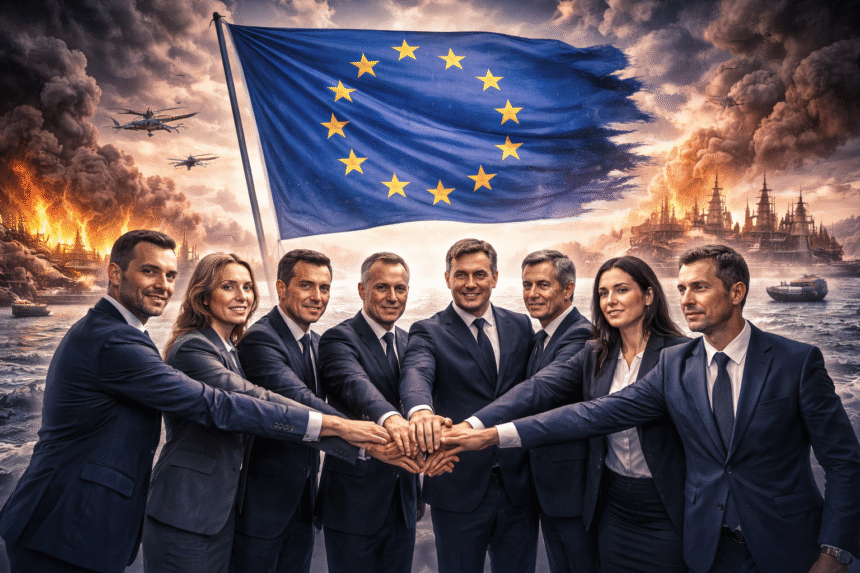
Germany’s Foreign Minister has emphasized that Europe will not allow internal disagreements to weaken its unity, even as member states of the European Union continue to hold differing positions on several major international crises.
Speaking during recent diplomatic discussions, the German minister acknowledged that debates and differences among European governments are natural, particularly when dealing with complex global conflicts and geopolitical challenges. However, he stressed that these differences should not be interpreted as a sign of fragmentation within the European project.
The remarks come at a time when the European Union is facing multiple international crises simultaneously, including tensions in the Middle East, the ongoing war in Ukraine, and growing concerns over global security and energy stability. These issues have prompted varying responses among EU member states, reflecting their different strategic priorities, economic interests, and political perspectives.
Despite these differences, Germany has urged European partners to maintain a shared commitment to cooperation and collective decision-making. According to the German Foreign Minister, the strength of the European Union lies in its ability to debate policies openly while ultimately working toward common solutions.
Berlin has also highlighted the importance of European unity in addressing global challenges such as economic volatility, energy security, migration pressures, and geopolitical competition between major powers. A fragmented Europe, officials warn, would weaken the continent’s influence on the global stage and make it harder to defend shared interests and values.
Germany, as one of the European Union’s largest economies and most influential political actors, continues to advocate for stronger coordination among member states in both foreign policy and security matters. The German government believes that maintaining unity is essential for Europe to remain a credible diplomatic and strategic actor internationally.
Analysts note that the minister’s statement reflects ongoing efforts by European leaders to reassure markets, allies, and citizens that internal disagreements will not undermine the broader European project. While policy debates are expected to continue, European officials insist that the commitment to unity remains a fundamental principle of the Union.
As global tensions evolve, the ability of European countries to balance national interests with collective action will likely remain a central test for the future of the European Union.