


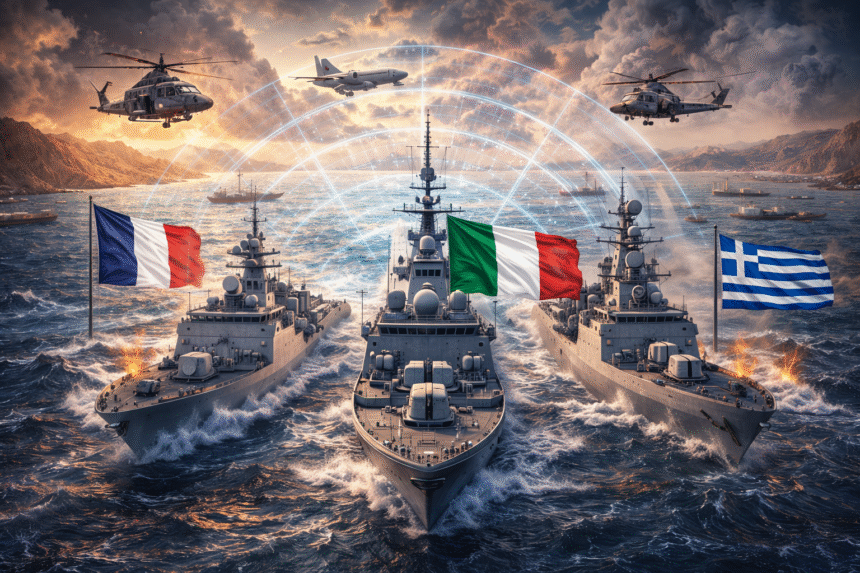
France, Italy, and Greece have begun coordinating military efforts to help secure international shipping routes in the Red Sea, a strategic maritime corridor that has faced increasing threats in recent months. The move reflects growing concern among European countries about the safety of global trade routes linking Europe, the Middle East, and Asia.
Officials from the three countries confirmed that naval assets and surveillance capabilities are being coordinated to monitor maritime activity and respond to potential threats targeting commercial vessels. The Red Sea remains one of the most critical shipping lanes in the world, carrying a significant portion of global energy supplies and international trade through the Bab el-Mandeb Strait toward the Suez Canal.
The joint coordination aims to strengthen maritime security by improving intelligence sharing, naval patrols, and rapid response capabilities. European naval forces operating in the region are expected to work closely with international partners to deter attacks on cargo ships and ensure the uninterrupted flow of goods.
In recent months, the Red Sea has witnessed rising tensions and security incidents that have forced shipping companies to reconsider routes or increase security measures. These developments have raised concerns in Europe about potential disruptions to supply chains and higher transportation costs.
France, Italy, and Greece—three countries with strong naval traditions and major interests in Mediterranean and global maritime trade—see the initiative as a necessary step to protect international shipping and safeguard economic stability.
European officials emphasize that the coordination is defensive in nature and aimed at protecting civilian vessels and maritime infrastructure. By strengthening naval presence and cooperation, the participating countries hope to maintain safe passage through one of the world’s most vital trade corridors.
Analysts say the move highlights Europe’s growing role in maritime security beyond its immediate neighborhood. As tensions continue to affect global shipping routes, European navies are increasingly expected to contribute to the protection of international trade and strategic waterways.