

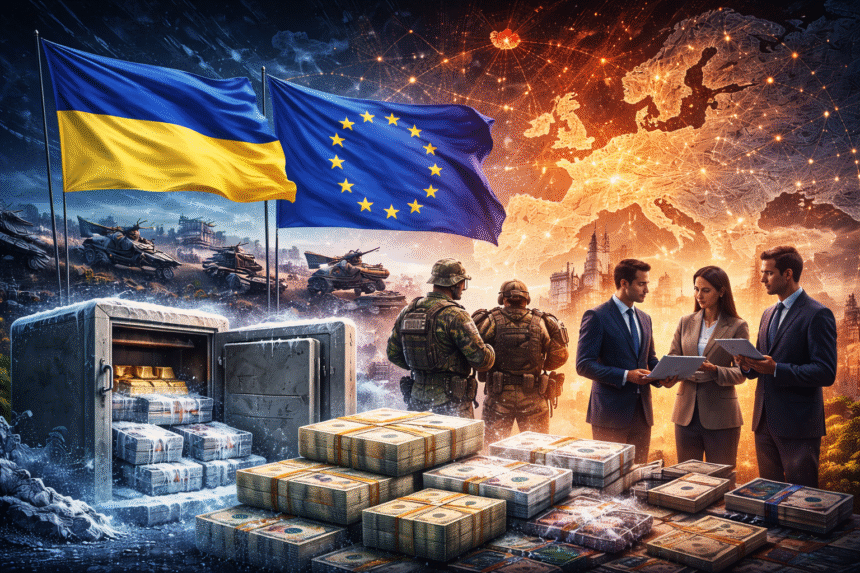
European Union leaders continue to reaffirm their commitment to supporting Ukraine, even as difficult discussions unfold over the conditions needed to end the war and how to finance long-term assistance — including the controversial proposal to use frozen Russian assets to repay a €90-billion loan.
At recent high-level meetings, EU officials stressed that Ukraine’s military and economic resilience remains a strategic priority. The proposed multi-year financial package is intended to stabilize Ukraine’s economy, support essential services, and sustain defense capabilities as the conflict shows little sign of resolution.
A Divisive Financial Strategy
A central point of contention involves whether profits from frozen Russian state and oligarch assets can legally be used to service or repay the loan. Some member states argue that Russia should bear financial responsibility for the damage caused by its invasion, viewing the move as both symbolic and practical.
Others warn that such action could set a precedent undermining financial stability and international law, potentially damaging Europe’s reputation as a secure place for global investments. Legal experts within the EU are currently examining options designed to ensure compliance while maintaining political pressure on Moscow.
Conditions for Ending the War
Parallel discussions continue over what negotiated conditions could eventually lead to peace. While there is broad European agreement on the need to respect Ukraine’s sovereignty, divisions persist regarding timelines, security guarantees, and reconstruction commitments.
Several governments emphasize that any settlement must not reward aggression, while others highlight the growing humanitarian and economic cost of a prolonged conflict.
Balancing Unity and Disagreement
Despite these debates, EU representatives repeatedly underline that unity remains intact on the core principle: Ukraine will not be abandoned. Humanitarian aid, military support, and economic assistance continue to flow — albeit with constant policy adjustments.
Analysts note that Europe’s internal disagreements reflect the complexity of designing a long-term strategy for a war whose outcome remains uncertain. The challenge lies in sustaining support while navigating legal constraints, public opinion, and geopolitical risks.
Looking Ahead
Negotiations over the loan structure and Russian assets are expected to continue in the coming months. Meanwhile, Kyiv remains hopeful that European backing — financial, political, and military — will endure as it faces ongoing pressure on the battlefield and at home.
For Europe, the debate is ultimately about more than financial tools: it is about defining how far the continent is willing to go to defend international norms, deter future aggression, and shape the post-war order.