

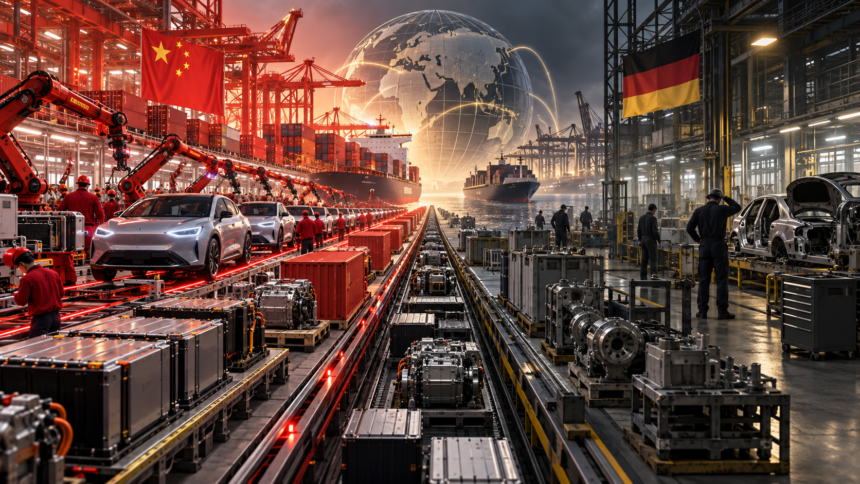
Germany’s export-driven industrial economy is facing growing pressure from China as Chinese manufacturers expand into markets traditionally dominated by European companies, according to research from the European Central Bank.
The study indicates that Germany is the most exposed to Chinese industrial competition among the European Union’s largest economies. The main reason is the significant similarity between the goods produced and exported by the two countries, particularly machinery, vehicles, electrical equipment, chemicals and other high-value manufactured products.
For decades, Germany benefited from China’s rapid economic growth. German companies supplied Chinese factories and consumers with cars, industrial machinery, chemicals and advanced engineering products. China was viewed as both a major customer and an important production base for German businesses.
That relationship is now changing. Chinese companies have strengthened their technological and manufacturing capabilities, allowing them to produce more goods domestically while competing directly with German manufacturers in international markets.
Instead of relying heavily on imported European equipment, China is increasingly supplying its own factories with locally produced machinery, components and technology. This shift has reduced Chinese demand for some European imports and placed additional pressure on German exporters.
The challenge is not limited to the Chinese market. German and Chinese companies are also competing for customers in Asia, Africa, Latin America and the Middle East. Chinese manufacturers often benefit from large-scale production, lower costs, extensive supply chains and government-backed industrial policies, making it difficult for some European companies to compete on price.
Germany’s automotive industry is among the sectors facing the greatest pressure. Chinese electric-vehicle manufacturers have expanded rapidly and are offering increasingly sophisticated cars at competitive prices. German automakers must now defend their market share both inside China and across Europe.
Manufacturers of machinery, batteries, renewable-energy equipment and electrical systems are confronting similar challenges. Products that were once associated with European technological leadership are increasingly being supplied by Chinese companies capable of producing them at scale.
Germany’s exposure is greater than that of countries such as Italy because German exports more closely resemble China’s expanding industrial output. This means German companies are more likely to encounter Chinese competitors in the same markets and product categories. (www.reuters.com)
The pressure arrives at a difficult time for German industry. Businesses are already dealing with elevated energy costs, labour shortages, complicated regulations and uncertainty surrounding global trade. Weak international demand and geopolitical tensions have also made long-term investment decisions more difficult.
However, the findings do not necessarily mean that Europe should attempt to cut economic ties with China. China remains an important market and a critical part of global manufacturing supply chains. A sudden separation would create significant costs for German companies that rely on Chinese customers, suppliers and production facilities.
Instead, European policymakers are being urged to strengthen domestic investment, support innovation and diversify supply chains. Improving access to affordable energy and accelerating the development of batteries, artificial intelligence, semiconductors and clean technologies could help European manufacturers remain competitive.
The ECB’s findings underline a fundamental change in the economic relationship between Europe and China. China is no longer simply a market for German industrial products; it has become one of Germany’s strongest manufacturing competitors. How Berlin and Brussels respond could determine whether German industry preserves its global position or continues losing ground in an increasingly competitive international economy.