


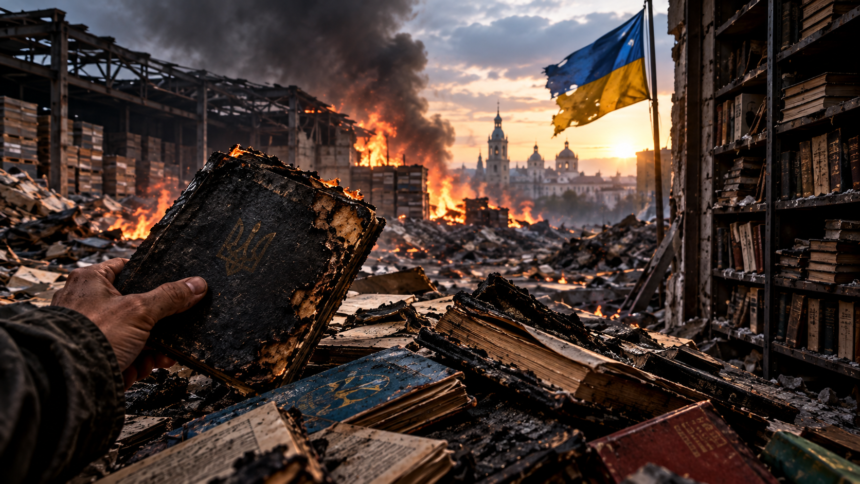
More than 10 million books have been destroyed in Ukraine in recent months as Russian attacks hit publishing warehouses, printing facilities and logistics centers, inflicting one of the most significant blows to the country’s book industry since the beginning of the war.
The scale of the destruction became particularly visible after a Russian drone strike on August 1 hit a warehouse belonging to Ranok, one of Ukraine’s largest children’s publishers, in the northeastern city of Kharkiv. The attack destroyed approximately eight million books stored at the facility, according to the publisher.
The Ranok strike followed several other attacks against Ukraine’s publishing infrastructure. On July 2, a Russian attack destroyed the central warehouse of Denka Logistics, where around 800,000 books belonging to publisher BookChef were stored. Other publishing, retail and logistics facilities have also suffered damage during recent attacks.
Taken together, Ukrainian publishers say more than 10 million books have been destroyed in attacks on warehouses in recent months. The losses include children’s books, educational materials, fiction and other publications that would otherwise have been distributed to bookstores, schools and readers across the country.
The destruction represents a serious economic challenge for an industry already operating under wartime conditions. Publishers must absorb the cost of lost inventories while confronting higher production expenses, disrupted supply chains, labor shortages and continuing uncertainty over whether newly printed books can be safely stored.
Replacing the lost stock is particularly difficult because publishing requires substantial upfront investment. Printing millions of replacement copies requires paper, printing capacity, financing, transportation and secure warehouse space at a time when many Ukrainian companies are already struggling with the broader economic consequences of the war.
The August attack on Ranok demonstrated the scale of that vulnerability. Images from Kharkiv showed huge quantities of burned books and warehouse debris after the strike, turning millions of finished publications into ash in a matter of hours.
Beyond the financial losses, the attacks have acquired a wider cultural significance. Ukrainian officials and publishing executives argue that the destruction threatens the country’s efforts to preserve and strengthen Ukrainian-language literature and cultural identity during the war.
The publishing crisis also forms part of the broader economic damage caused by the conflict. Ukraine’s economy remains roughly 20% smaller than before the full-scale Russian invasion, while repeated attacks on infrastructure continue to complicate attempts to restore sustainable economic growth.
For Ukraine’s publishers, however, the consequences cannot be measured solely in financial terms. Every destroyed warehouse represents years of editorial work, printing and investment, while every lost collection reduces the supply of books reaching Ukrainian families, children, schools and libraries.
The destruction of more than 10 million books therefore illustrates another dimension of the war: alongside the human, military and economic costs, Ukraine is confronting an increasingly significant struggle to protect the institutions and cultural industries that preserve its language, literature and national identity.