

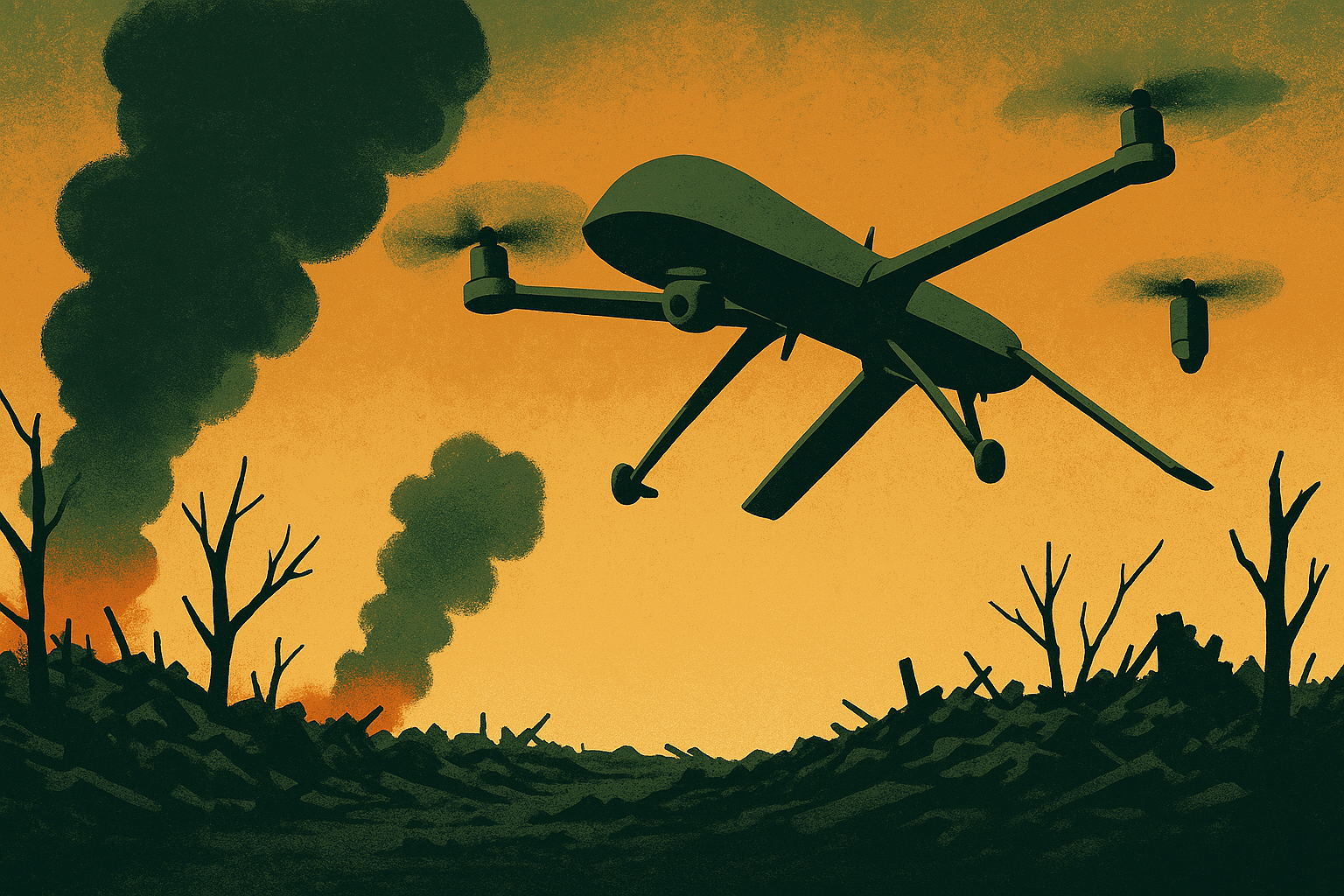
For years, Ukrainian drone operators held a major tactical advantage on the battlefield, using small, inexpensive drones to strike Russian troops with speed and creativity. But a new and highly organised Russian force — known as Rubikon — has reversed that balance, hunting drone pilots deep behind the front line and threatening one of Kyiv’s most important military assets.
Ukrainian Drone Pilots Become the Hunted
Ukrainian drone pilot Dmytro experienced the growing danger firsthand when a Russian quadcopter suddenly appeared above him during what he called a “very bad decision” to walk in the woods near the frontline.
Accustomed to monitoring Russians from a hidden bunker while controlling attack drones, he found himself running for his life. “It’s disorienting to be shot at when you are used to being the one operating the drone,” he said.
Stories like his are becoming increasingly common. After nearly two years of dominating drone warfare, Ukraine’s pilots now face a formidable adversary actively tracking, locating, and eliminating them before they can launch.
Rubikon: A New, Highly Resourced Russian Drone Force
Rubikon is an elite Russian formation with roughly 5,000 personnel and significant financial backing, according to Rob Lee of the Foreign Policy Research Institute. The unit’s mission is not to attack infantry directly, but to destroy the operators driving Ukraine’s drone advantage.
Using advanced detection tools and its own fleet of hunter drones, Rubikon strikes up to 10km behind Ukrainian lines, targeting drone pilots, vehicles, and robotic systems used to supply front-line positions.
The group also functions as a hub for research, training, and development of drone tactics, effectively acting as a national centre for Russia’s unmanned warfare efforts. Russian units that train under Rubikon, analysts say, show marked improvement in performance.
“This is more than a drone unit — it is a centre for innovation,” said Lee. “They don’t operate like the traditional Russian military. They move faster, take initiative, and adapt.”
Rewriting the Rules of Drone Warfare
The rise of Rubikon has dramatically changed the digital battlefield. Drone warfare now accounts for 70%–80% of military casualties, according to Ukrainian and Western analysts. Controlling the electromagnetic spectrum — not just the air — has become vital.
Both Russia and Ukraine deploy large jammers, radio direction finders, and electronic warfare tools to hack or block enemy drones. But these systems also emit strong electronic signatures, making them vulnerable to strikes.
“It’s a cat-and-mouse game,” said Tom Withington, an electronic warfare expert at the Royal United Services Institute. “Whoever dominates the electromagnetic spectrum gains the upper hand.”
Rubikon’s resources allow it to operate around the clock. Ukrainian operators, on the other hand, often run small teams, struggling with exhaustion and limited manpower.
“They rotate every five hours,” said Zoommer, a Ukrainian pilot near Pokrovsk. “We don’t have that luxury. We still need to sleep.”
Ukrainian Front Lines Under Strain
The unit’s operations have been especially damaging near Pokrovsk, a strategic city in Donetsk now facing intense Russian pressure. Ukrainian troops say Russian infantry can advance more effectively thanks to Rubikon’s ability to neutralise or disrupt Ukrainian drones.
“If Russia didn’t have such skilled drone operators, their infantry wouldn’t be able to infiltrate the city,” said Ukrainian serviceman Artem Kariakin. “It is extremely dangerous to be a drone operator right now.”
Ukrainian pilots are now frequently forced to move, hide, or stay silent for long stretches to avoid detection. Rubikon identifies potential command points — such as hilltops and rooftops — by scanning for antennas and radio emissions.
“We must mask everything,” said Dmytro. “Be silent, be humble, don’t move unless it’s necessary.”
Ukraine Adapts — But Faces a Growing Challenge
To counter the threat, some Ukrainian brigades have begun forming anti-drone teams tasked with hunting Russian operators in return. Pilots also rotate locations, change transmission frequencies, and use improved camouflage.
Still, experts warn that Ukraine needs a more centralised, coordinated battle plan to match Rubikon’s scale and organisation.
“Russia has learned quickly from Ukraine,” said Bob Tollast, a research fellow at RUSI. “Now Kyiv must adapt again.”
For drone pilots like Dmytro, the new rules of survival are simple:
“No walks, no breaks. Sit in your trench, stay hidden, and don’t give yourself away — even if you just want 20 minutes of fresh air.”