


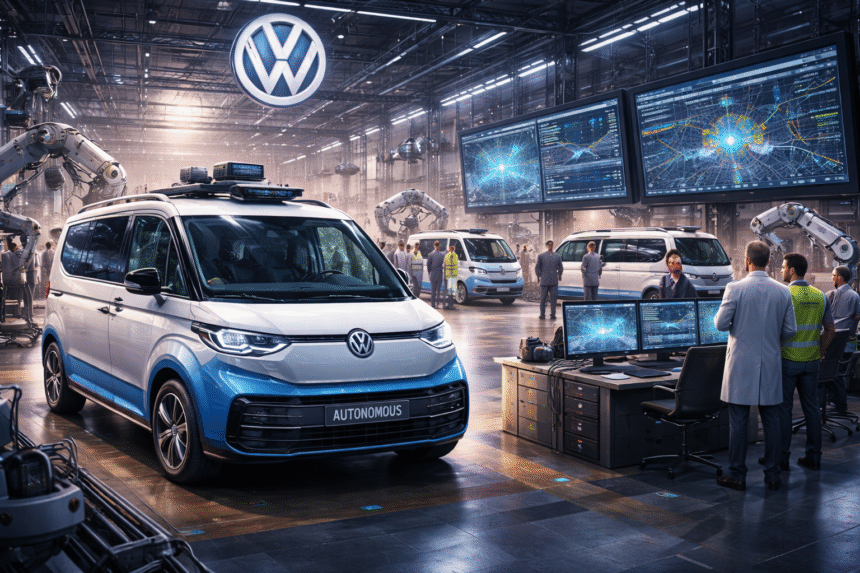
German automotive giant Volkswagen has announced plans to begin producing self-driving commercial vehicles in Europe by 2027, marking a significant step forward in the company’s strategy to expand its presence in the rapidly evolving autonomous mobility sector.
A Major Step Toward Autonomous Transport
Volkswagen’s project focuses on developing autonomous electric vans designed primarily for commercial use. The vehicles are expected to be used in logistics, ride-sharing services, and urban mobility solutions, reflecting growing demand for automated transportation technologies in major cities.
The company believes that self-driving commercial vehicles could play a crucial role in improving efficiency in delivery services and reducing operational costs for businesses.
Focus on Urban Mobility
The autonomous vehicles are being designed with urban environments in mind. As cities across Europe face increasing traffic congestion and environmental concerns, automated commercial vehicles could offer a more efficient and sustainable transportation model.
By combining electric propulsion with autonomous driving systems, Volkswagen aims to create vehicles that reduce emissions while optimizing transportation networks.
Technology Development
The development of the autonomous system is being carried out through Volkswagen’s software and mobility technology divisions. The vehicles are expected to rely on a combination of advanced sensors, artificial intelligence, high-resolution mapping, and real-time data processing to navigate complex city environments safely.
The company has been testing prototype vehicles in several European locations as part of its efforts to refine the technology ahead of full-scale production.
Partnerships and Industry Competition
Volkswagen’s move places it in direct competition with several global technology and automotive companies investing heavily in autonomous mobility. Companies in the United States, China, and Europe are racing to develop reliable self-driving systems that can operate safely in real-world conditions.
Industry analysts say the commercial vehicle sector may adopt autonomous technology faster than private passenger vehicles, particularly in controlled environments such as delivery routes and logistics hubs.
Regulatory Challenges
Despite technological progress, the widespread adoption of autonomous vehicles still faces regulatory hurdles. European governments are currently working to establish legal frameworks that would allow driverless vehicles to operate safely on public roads.
Volkswagen has indicated that it is cooperating closely with regulators to ensure its vehicles comply with future safety and operational standards.
Transforming the Transport Industry
If successful, the introduction of autonomous commercial vehicles could significantly reshape the transportation and logistics industries. Businesses may benefit from lower operational costs, improved efficiency, and the ability to operate vehicles for longer hours without human drivers.
At the same time, the shift toward automation raises broader questions about the future of employment in transportation sectors and the pace at which autonomous technology will transform global mobility.
Looking Ahead to 2027
Volkswagen’s plan to produce self-driving commercial vehicles by 2027 signals the company’s ambition to remain a major player in the next generation of transportation technology.
As testing and development continue, the project could become one of Europe’s most significant steps toward integrating autonomous mobility into everyday commercial transport.