


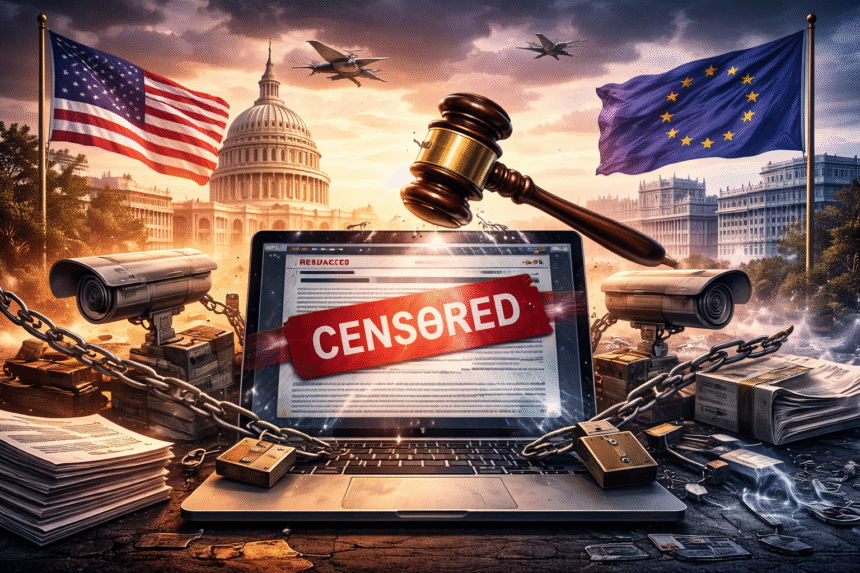
A newly released American policy report has sharply criticized European Union regulations governing online speech, claiming that Brussels is spearheading a “global censorship campaign” that threatens political expression beyond Europe’s borders. The report, published by a U.S.-based policy institute and discussed during a congressional hearing this week, has reignited transatlantic tensions over digital regulation, sovereignty, and free speech.
The Core Accusation
The report argues that recent European legislation — particularly the Digital Services Act (DSA) — gives regulators sweeping authority to compel major technology platforms to remove or restrict political content deemed harmful or misleading. Critics in Washington claim that because many large platforms operate globally, EU rules effectively shape online speech standards worldwide.
According to the authors, the EU’s enforcement model creates what they call a “Brussels Effect” in digital governance — where companies adopt the strictest regulatory framework across all markets rather than tailoring moderation rules country by country.
The report frames this as a structural risk to political discourse, alleging that “content moderation mandates are increasingly political in nature,” especially when applied to elections, migration debates, public health policy, and foreign affairs.
Concerns Raised in Washington
During a U.S. congressional hearing on transatlantic digital policy, several lawmakers expressed concern that American citizens’ speech could be indirectly affected by European regulatory decisions.
Some officials argued that:
- Platforms may over-remove content to avoid EU fines.
- Political speech could be categorized as “disinformation” under broad interpretations.
- Non-European users might experience spillover effects from EU compliance standards.
Supporters of the report described the EU’s regulatory model as “extraterritorial influence” on free expression norms.
Brussels Pushes Back
European officials have firmly rejected the censorship claim.
EU representatives emphasize that:
- The Digital Services Act targets illegal content, systemic risks, and coordinated disinformation campaigns.
- The law does not authorize governments to directly remove lawful political speech.
- Independent judicial oversight and transparency mechanisms are built into enforcement procedures.
Brussels argues that its approach is focused on platform accountability rather than speech suppression. EU policymakers also contend that regulating online harm — including foreign interference, hate speech, and coordinated manipulation — is essential to protecting democratic systems.
An EU official responding to the criticism stated that “protecting democracy online is not censorship — it is a safeguard.”
A Broader Transatlantic Divide
The debate reflects a deeper philosophical difference between American and European free speech traditions:
- The United States tends to prioritize maximal speech protections under the First Amendment, even when content is controversial.
- The European Union balances speech protections with other legal principles, including dignity, anti-hate laws, and prevention of extremist propaganda.
Digital governance has become one of the most sensitive policy areas between the two sides, alongside trade, defense, and technology competition.
Tech Industry Caught in the Middle
Major technology companies now find themselves navigating:
- U.S. political pressure against content moderation.
- EU regulatory obligations requiring risk mitigation and transparency.
- Growing public scrutiny in both jurisdictions.
Executives privately acknowledge that complying with multiple regulatory regimes increases operational complexity and legal exposure.
What Comes Next
While the American report does not carry formal legal authority, it may influence future legislative proposals in Congress aimed at limiting foreign regulatory influence over U.S.-based platforms.
For Brussels, the controversy underscores the global impact of its digital rule-making power. As enforcement of the Digital Services Act accelerates, scrutiny from Washington is likely to intensify.
The dispute signals that the future of online political speech will not only be shaped in Silicon Valley — but increasingly in Brussels and Washington alike.