

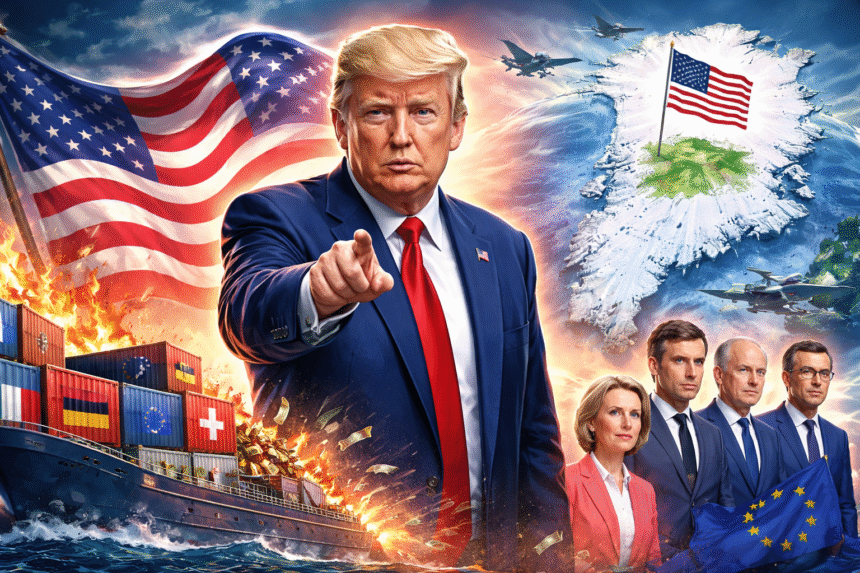
In a dramatic escalation of tensions between Washington and its closest allies in Europe, U.S. President Donald Trump has openly tied his threats to impose tariffs on several European countries to his frustration over not being awarded the Nobel Peace Prize — and to his renewed push for American control of Greenland.
In a message sent to Norwegian Prime Minister Jonas Gahr Støre, Trump said that because the Nobel Committee chose someone else for the Peace Prize, he “no longer feels obligated to think purely of peace,” signaling a shift in U.S. foreign policy priorities toward what he described as “what is good and proper for the United States of America.”
Tariff Threats as Leverage
Trump’s message came in the midst of an ongoing dispute over Greenland, the vast Arctic island that is an autonomous territory of Denmark. Trump has repeatedly argued that the United States should acquire the island, claiming it is vital for national security and would prevent Russia and China from gaining influence in the Arctic.
Last weekend, Trump announced that eight European countries — Denmark, Norway, Sweden, France, Germany, the United Kingdom, the Netherlands, and Finland — will face at least a 10% tariff on imports starting February 1, with the duty rising to 25% by June unless a deal is reached for the “complete and total purchase” of Greenland.
European allies described the move as a form of coercion that could undermine long-standing transatlantic relations. “Applying tariffs on allies because they support collective security and sovereignty is completely wrong,” said UK Prime Minister Keir Starmer.
European Pushback and Unity
European leaders responded angrily to the tariff threats and Trump’s linkage to the Nobel Peace Prize. French President Emmanuel Macron called the tariff threats “unacceptable” and insisted that neither threats nor intimidation would influence European positions on Greenland or other strategic issues.
European Union officials have also indicated they are preparing to respond. Brussels is considering activating an “anti-coercion instrument” — a trade defense measure that could allow retaliatory tariffs or other restrictions on U.S. goods and services should Trump’s tariffs go into effect. Germany and France have led calls for unity, though some EU members urge caution to avoid a full-blown trade war.
The ongoing dispute has added strain to NATO cohesion, with European capitals emphasizing that Greenland is firmly a part of the Kingdom of Denmark and calling on dialogue instead of punitive economic measures.
Greenland’s Reaction and Regional Impact
Thousands of Greenlanders and Danish supporters have protested Trump’s stance under the slogan “Greenland is not for sale,” reflecting strong local resistance to any notion of American acquisition. Denmark and Greenland’s leadership have repeatedly stated that the island will not be sold under any circumstances.
In response to the tariff announcement, European and Greenlandic officials are reinforcing their commitment to sovereignty and international law, while also coordinating diplomatic efforts to ease tensions with Washington.
Broader Diplomatic Implications
Analysts say the conflict reflects broader rifts in U.S.-European relations, particularly over trade, NATO strategy, and emerging geopolitical competition with Russia and China. By linking the Nobel Peace Prize snub to what critics call an assertive territorial ambition, Trump has introduced a personal dimension into an already complex diplomatic situation — one that could reshape transatlantic ties in the months ahead.