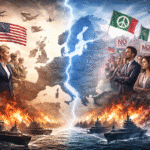


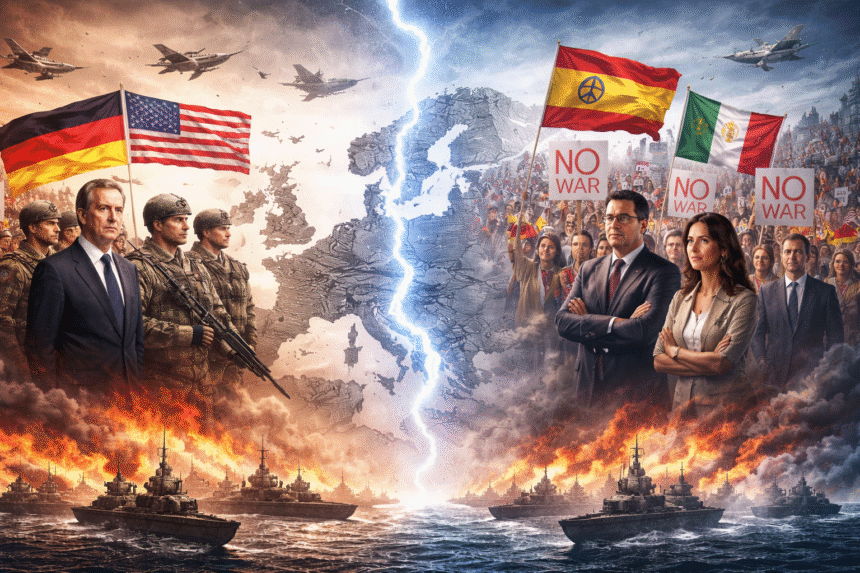
As the war between the United States and Iran intensifies, Europe’s response has become increasingly fragmented. At the center of this divide are two contrasting approaches: cautious alignment with Washington, led by countries like Germany, and firm opposition to military escalation, championed by Spain and several other European nations. This split reflects deeper differences in strategic culture, economic priorities, and historical experience.
Germany’s Cautious Alignment
Germany has taken a measured and pragmatic stance toward the conflict. Rather than offering full military endorsement, Berlin has opted for what can be described as “controlled support”—maintaining its transatlantic alliance while avoiding direct involvement in combat operations.
This approach is shaped by several factors. First, Germany’s long-standing commitment to NATO and its strategic partnership with the United States encourages political alignment, especially on security matters. Second, Berlin is wary of destabilizing global markets, particularly energy supplies, which are critical to its industrial economy.
However, Germany’s support remains cautious. Officials have consistently emphasized diplomacy and restraint, signaling discomfort with a prolonged or expanded conflict. The goal is clear: support the alliance without being drawn into another costly and unpredictable war.
Spain’s Firm Opposition to Escalation
In contrast, Spain has emerged as one of the strongest European voices against military escalation. Madrid has openly rejected participation in offensive operations and has called for an immediate ceasefire and a return to negotiations.
Spain’s position is rooted in both domestic and historical considerations. Public opinion in the country remains largely skeptical of foreign military interventions, particularly after the legacy of past conflicts such as Iraq. Politically, the government faces pressure from parties and civil society groups that prioritize diplomacy over confrontation.
By distancing itself from military involvement, Spain is positioning itself as a diplomatic actor, advocating for de-escalation and international mediation rather than alignment with U.S. military strategy.
A Wider European Divide
The divergence between Germany and Spain is not an isolated case—it reflects a broader European split.
- Northern and Eastern European countries tend to lean closer to Washington, viewing U.S. leadership as essential for security, especially in light of ongoing tensions with Russia.
- Southern and some Western European nations are more skeptical, prioritizing economic stability and fearing the consequences of another major conflict in the Middle East.
This divide is further amplified by differences in energy dependence, military capacity, and political ideology across the continent.
The Impact on European Unity
The contrasting positions are raising questions about Europe’s ability to act as a unified geopolitical actor. While the European Union continues to call for diplomacy, the lack of a single, coherent strategy weakens its influence on the global stage.
Instead of presenting a united front, Europe appears divided between strategic alignment and strategic autonomy—a tension that has defined its foreign policy for years but is now more visible than ever.
Conclusion
Germany’s cautious support for Washington and Spain’s rejection of military escalation encapsulate the broader dilemma facing Europe. Caught between alliance commitments and the risks of conflict, European nations are navigating a complex and uncertain landscape.
As the war continues, this divide may deepen, shaping not only Europe’s response to the current crisis but also its future role in global security and diplomacy.