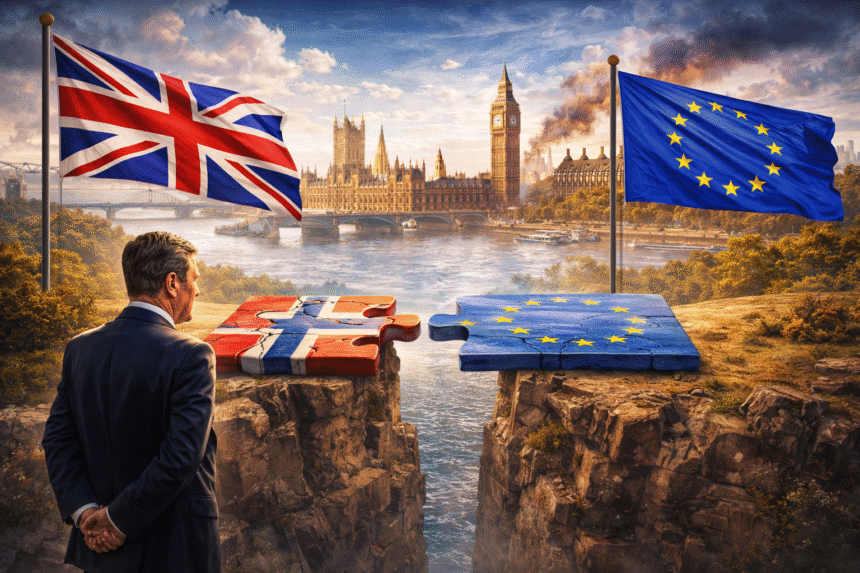
UK Prime Minister Keir Starmer is facing growing pressure from political figures, business leaders, and policy experts to recalibrate his government’s approach to the European Union, amid renewed debate over the long-term impact of Brexit on Britain’s economy and global standing.
While Starmer has maintained that the UK will not rejoin the EU or its single market, voices within his own party and across the business community are increasingly calling for a more pragmatic and cooperative relationship with Brussels. They argue that current trade arrangements are creating unnecessary barriers, slowing economic growth, and complicating supply chains.
The push for closer ties comes at a time when the UK economy is navigating persistent challenges, including inflationary pressures, weak productivity growth, and shifting global trade dynamics. Critics of the current approach contend that easing trade frictions with the EU—Britain’s largest trading partner—could provide a much-needed economic boost.
Among the proposals gaining traction are measures to align certain regulatory standards with the EU, negotiate improved access for key industries, and expand cooperation in areas such as energy, security, and research. Some advocates have even suggested revisiting aspects of the Brexit agreement to reduce bureaucratic hurdles for businesses.
However, Starmer remains cautious, balancing economic considerations with political realities. Reopening the Brexit debate carries significant risks, particularly given the continued sensitivity of the issue among voters. The government has emphasized its focus on making Brexit “work better” rather than reversing it.
Within the Labour Party, the debate reflects broader tensions between those seeking incremental improvements and others who favor a more ambitious reset of UK-EU relations. Meanwhile, opposition parties and pro-European groups are intensifying calls for deeper engagement, arguing that the costs of distance are becoming increasingly evident.
Analysts note that the evolving geopolitical landscape—marked by economic uncertainty and security challenges—may further strengthen the case for closer cooperation between the UK and the EU. As Europe grapples with shared issues such as energy security and regional stability, the pressure on the UK government to align more closely with its neighbors is likely to grow.
For now, Starmer faces a delicate balancing act: responding to mounting domestic and economic pressures while maintaining a politically viable stance on one of the most defining issues in modern British history.