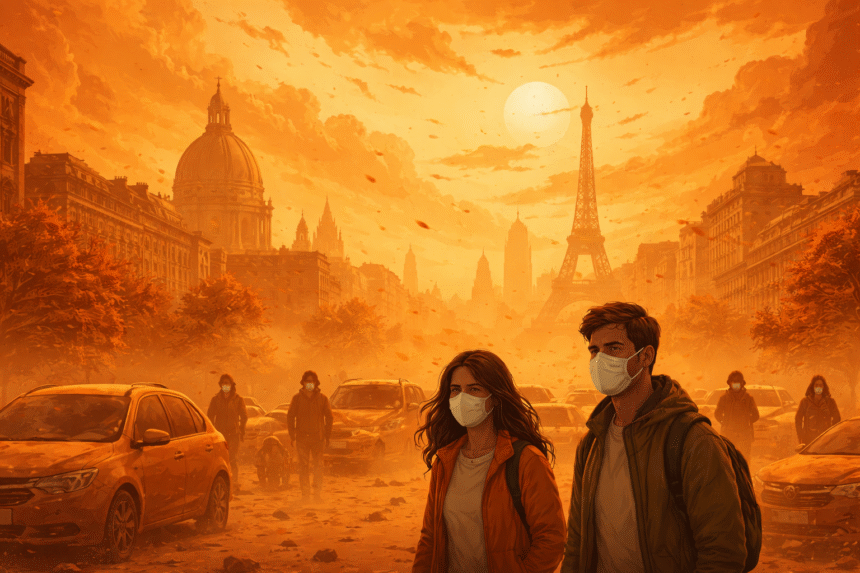
A vast cloud of desert dust sweeping north from Africa has transformed skies across several European countries into an eerie orange hue, while triggering widespread health concerns and environmental disruptions. The phenomenon, driven by strong winds carrying fine particles from the Sahara Desert, has affected countries including Spain, France, Italy, and parts of Central Europe.
Meteorologists report that this surge of Saharan dust—often referred to as “calima”—has intensified due to shifting atmospheric pressure systems over North Africa and the Mediterranean. These systems have lifted massive amounts of dust into the upper atmosphere, allowing it to travel thousands of kilometers into Europe.
In many cities, the sky has taken on a dramatic orange or reddish tint, reducing visibility and creating apocalyptic-like scenes. Rainfall mixed with the airborne particles has led to “mud rain,” leaving cars, buildings, and streets coated in a layer of reddish-brown residue.
Authorities across affected regions have issued health advisories, warning of deteriorating air quality levels. Fine particulate matter (PM10 and PM2.5) has surged well above safe limits, posing serious risks—especially for vulnerable groups.
People with respiratory conditions such as asthma and chronic bronchitis are particularly at risk, while even healthy individuals may experience:
- Irritation of the eyes and throat
- Breathing difficulties
- Increased fatigue and headaches
Health agencies have urged residents to limit outdoor activities, wear protective masks, and keep windows closed during peak dust periods.
Beyond health, the dust cloud has disrupted daily life and infrastructure. Reduced visibility has affected aviation in some regions, while the accumulation of dust has impacted solar energy production by coating panels and reducing efficiency.
Agricultural sectors are also monitoring potential effects. While Saharan dust can sometimes enrich soils with minerals, excessive deposits can harm crops and contaminate water sources.
Experts note that such events are not new but may be becoming more frequent and intense due to climate change. Rising temperatures and desertification in North Africa are increasing the likelihood of large-scale dust emissions.
Scientists warn that Europe may need to prepare for more frequent episodes of transcontinental dust transport, which could have long-term implications for public health, climate patterns, and environmental stability.
This latest episode highlights the interconnected nature of global climate systems. What begins as a storm in the Sahara can quickly evolve into a continent-wide environmental event, underscoring the growing impact of climate variability across regions.
As orange skies fade and the dust settles, European authorities continue to monitor air quality and assess the aftermath—while experts emphasize the need for stronger climate resilience strategies in the face of increasingly unpredictable weather patterns.