


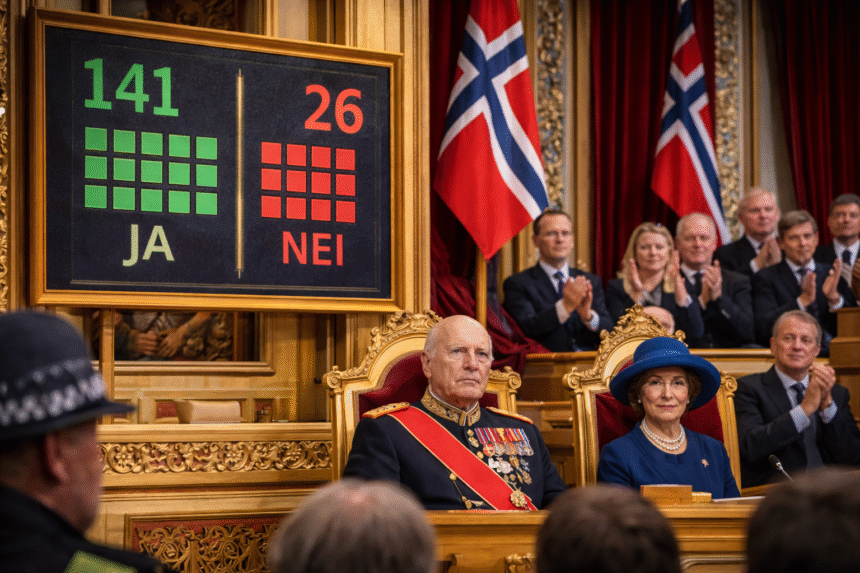
Norway’s parliament voted overwhelmingly to maintain the country’s constitutional monarchy, rejecting a proposal to abolish the institution even as the royal family faces ongoing controversies and public debate.
In a session on Tuesday, 141 out of 169 members of the Storting supported keeping the monarchy, while just 26 lawmakers voted in favour of transitioning to a republic with an elected head of state. The result underscored broad legislative support for the monarchy despite recent public scrutiny.
The vote came amid a series of scandals and pressures on the royal household that have stirred national conversation about its role in modern Norwegian society. These include criticism of Crown Princess Mette-Marit’s past association with convicted sex offender Jeffrey Epstein, for which she publicly apologised, and the high-profile legal proceedings involving her son, Marius Borg Høiby, who stands trial on a range of serious charges.
Supporters of the monarchy argued that the institution remains a symbol of national unity and stability, providing continuity above everyday political conflicts. Norway’s monarchy is largely ceremonial, with executive and legislative powers resting with elected officials, but backers say it plays an important role in representing the country domestically and internationally.
Opposition to the monarchy has grown in parts of Norwegian society, with critics arguing that an inherited head of state is at odds with democratic principles and that leadership should be elected. Recent polling showed that public support for the monarchy has dipped compared with previous years, and support for a republic has increased. Nevertheless, the parliamentary vote confirmed that the monarchy still retains strong institutional backing within Norway’s political establishment.
The vote ensures that King Harald V and the royal institution remain central to Norway’s constitutional framework. Debates over the monarchy’s future are expected to continue, especially as public opinion evolves and new generations weigh the relevance of royal tradition in a modern democracy.