

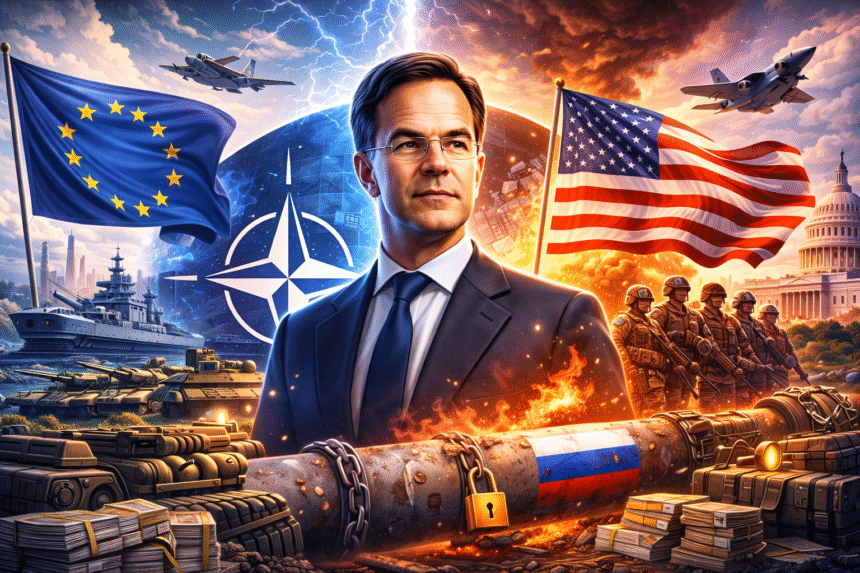
NATO Secretary General Mark Rutte has warned that Europe is currently unable to defend itself without the support of the United States, urging European countries to significantly increase their defense spending and military capabilities. His remarks come amid growing geopolitical tensions and renewed debates over Europe’s security responsibilities within the transatlantic alliance.
Speaking amid discussions on NATO’s future posture, Rutte stressed that while Europe has made progress in strengthening its defense since the start of the war in Ukraine, it remains heavily dependent on U.S. military power in key areas. These include strategic airlift, intelligence and surveillance, missile defense, advanced command-and-control systems, and nuclear deterrence.
Rutte argued that this imbalance poses long-term risks to Europe’s security and credibility. He emphasized that a stronger European defense is not about weakening NATO or distancing the continent from Washington, but about reinforcing the alliance by ensuring a more equitable sharing of responsibilities. “A stronger Europe makes NATO stronger,” he said, underlining that transatlantic unity remains essential in the face of global threats.
The NATO chief called on member states to move beyond political commitments and deliver concrete increases in defense budgets, equipment production, and military readiness. He reiterated that the alliance’s benchmark of spending at least 2 percent of GDP on defense should be treated as a minimum rather than a ceiling, particularly as Russia continues its military aggression and other security challenges emerge on NATO’s southern and eastern flanks.
Rutte also highlighted the need to expand Europe’s defense industrial base, warning that current production levels are insufficient to sustain long-term deterrence or support allies in times of crisis. Faster procurement, joint European defense projects, and reduced bureaucratic obstacles were among the measures he said are necessary to close critical capability gaps.
His comments have added momentum to ongoing debates within the European Union about strategic autonomy and collective defense. While some European leaders advocate greater independence in security matters, Rutte cautioned against any illusion that Europe can replace the United States in the near term. Instead, he framed increased European defense efforts as a way to ensure NATO’s resilience and to maintain U.S. engagement in Europe.
The statement reflects a broader reassessment of European security in an era of heightened uncertainty. As NATO adapts to evolving threats, Rutte’s message underscores a central reality: Europe must invest more in its own defense, not to stand alone, but to stand stronger alongside the United States within the alliance.