


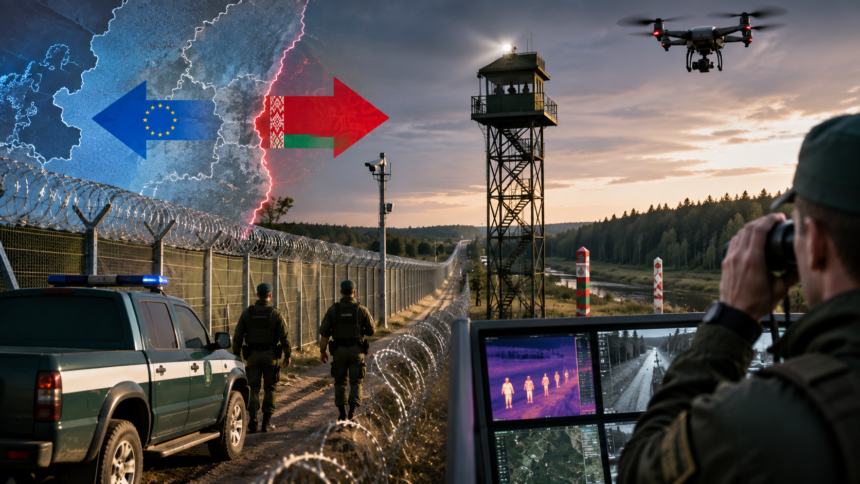
Latvia is stepping up security along its eastern frontier with Belarus as a sharp increase in irregular border crossings puts renewed pressure on one of the European Union’s most sensitive external borders.
The Latvian government launched a special security operation, known as “Vilkatis” or “Werewolf,” on August 11, bringing together border guards, police, military personnel and security services. Authorities said the operation will run through the end of August and will focus on stopping illegal crossings and dismantling networks suspected of helping migrants move from Belarus through Latvia and onward into other European countries.
The latest escalation followed the discovery of a tunnel beneath the Latvia-Belarus border, which Latvian authorities believe was being used to facilitate illegal crossings. The discovery intensified concerns that increasingly organized smuggling networks are operating along the frontier. Latvia has responded by strengthening patrols, increasing drone surveillance and doubling the number of border guards in sensitive areas.
Pressure has been building throughout the year. Latvian authorities have reported more than 8,000 attempted crossings of the eastern border in 2026, while neighboring countries have deployed personnel to support Latvia. Estonia sent another rotating police and border-guard unit earlier this month to assist Latvian forces.
Latvian officials describe the migration pressure as part of a broader “hybrid threat” linked to Belarus, an accusation Minsk has rejected. Riga says it has evidence that Belarusian border personnel have assisted in transporting migrants toward areas from which they attempt to enter Latvia.
The security situation has already produced tense encounters. In July, Latvian soldiers used tear gas and fired a warning shot during an attempt to stop a group of migrants crossing from Belarus, illustrating how increasingly confrontational conditions have become along the frontier.
Latvia is also continuing to expand physical and technological defenses along its eastern border, including fencing, patrol roads and video-surveillance systems. Officials have said additional personnel may be required, with the State Border Guard describing the situation on the Belarusian frontier as increasingly serious.
The developments are once again putting the EU’s eastern frontier in the spotlight. Latvia, Lithuania and Poland have faced migration pressure from Belarus since 2021, and Riga is now seeking closer coordination with its Baltic neighbors and Poland as authorities attempt to prevent irregular migration routes from becoming permanently established across the region.