

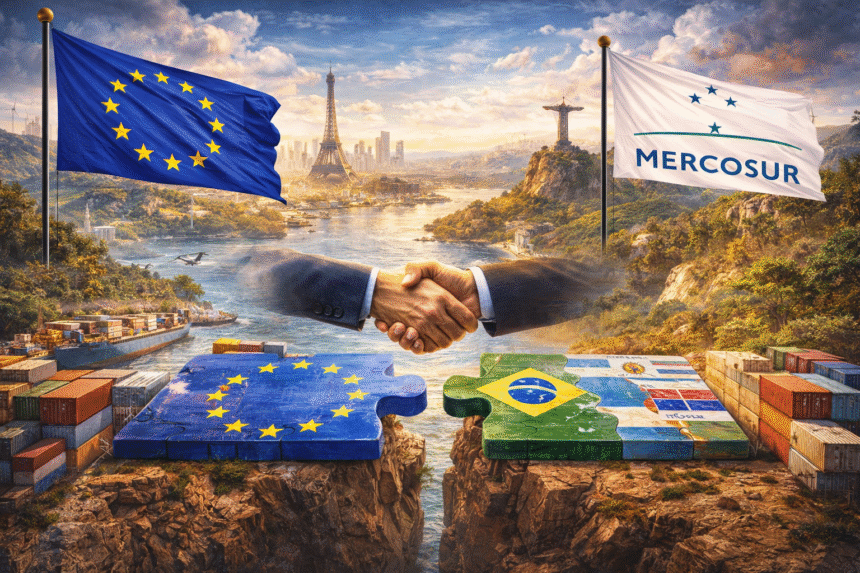
The European Union and the Mercosur bloc have reached a historic trade agreement, marking a major milestone in global economic integration. The deal, which brings together more than 700 million people across Europe and South America, is set to establish one of the largest free trade areas in the world—reshaping trade flows, investment patterns, and geopolitical alignments.
Mercosur, which includes Brazil, Argentina, Paraguay, and Uruguay, represents a vast and resource-rich market, while the European Union remains one of the world’s largest economic powers. By reducing tariffs and easing trade barriers between the two blocs, the agreement aims to unlock significant economic opportunities for both sides.
Under the terms of the deal, tariffs on a wide range of goods—including agricultural products, industrial machinery, and automobiles—are expected to be gradually reduced or eliminated. European exporters stand to gain improved access to South American markets, while Mercosur countries are likely to benefit from increased exports of commodities such as beef, soy, and minerals.
Beyond trade, the agreement also includes provisions to promote investment, enhance regulatory cooperation, and strengthen supply chains. European companies are expected to expand their presence in South America, while businesses in Mercosur countries may gain greater access to European technologies and capital.
Supporters of the deal argue that it will boost economic growth, create jobs, and provide consumers with more competitive prices and a wider range of goods. They also view the agreement as a strategic move to reinforce economic alliances at a time of increasing global uncertainty and shifting trade dynamics.
However, the agreement has not been without controversy. Critics in Europe have raised concerns about environmental standards, particularly regarding deforestation in the Amazon, as well as the potential impact on local farmers facing increased competition. Labor protections and regulatory alignment have also been points of debate.
Despite these concerns, policymakers on both sides emphasize that the agreement includes safeguards and mechanisms to address environmental and social issues, aiming to balance economic benefits with sustainable development goals.
As the EU–Mercosur deal moves toward implementation, it signals a renewed commitment to multilateral trade and cooperation. In an era marked by protectionism and geopolitical tensions, the agreement stands out as a significant step toward deeper economic connectivity between continents.