

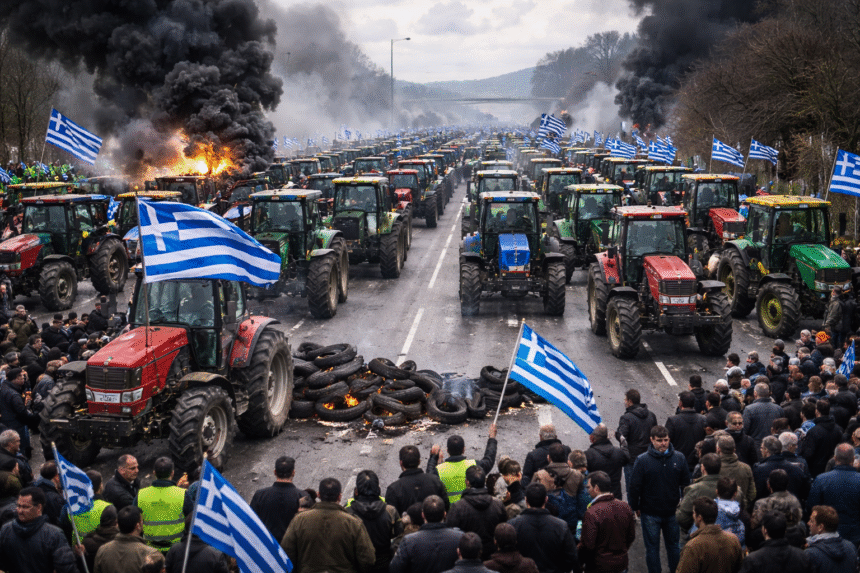
Farmers across Greece have intensified nationwide protests by blocking major highways and transport routes, voicing anger over soaring production costs and a controversial trade agreement between the European Union and South American countries under the Mercosur framework.
Tractors lined key roads in several regions, bringing traffic to a standstill and disrupting supply chains as farmers warned that their livelihoods are increasingly under threat. Protesters argue that the combined pressure of rising fuel prices, fertilizer costs, animal feed expenses, and energy bills has pushed many farms to the brink of financial collapse.
Opposition to the EU–South America Trade Deal
At the center of the protests is strong opposition to the EU–Mercosur trade agreement, which farmers fear will open European markets to cheaper agricultural imports produced under looser environmental and labor standards. Greek farming unions say this would undermine local producers, particularly small and medium-sized farms already struggling to remain competitive.
Protest leaders argue that while European farmers are required to comply with strict environmental and safety regulations, imported products would not face the same constraints, creating what they describe as “unfair competition.”
Economic Pressures and Rural Discontent
Greek farmers have long complained that subsidies and compensation mechanisms fail to keep pace with real production costs. Many say their incomes have stagnated or fallen, even as consumer prices rise, widening the gap between farmgate prices and retail profits.
The protests reflect broader rural discontent across Europe, where similar demonstrations have erupted in recent months over agricultural policy, climate regulations, and trade liberalization.
Government and EU Response
Greek authorities have called for dialogue and urged protesters to reopen blocked roads, citing economic disruption and public safety concerns. Meanwhile, EU officials have defended the trade agreement as strategically important but acknowledged the need for safeguards to protect European farmers.