

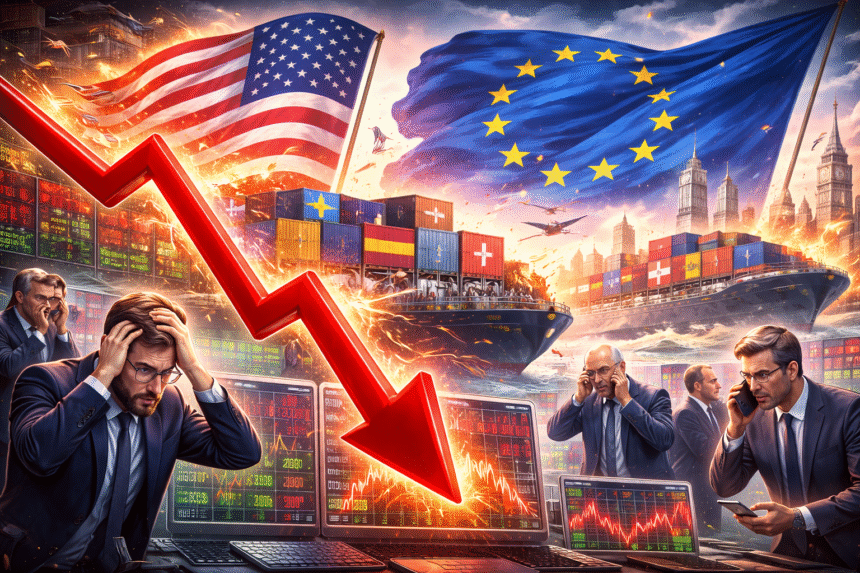
Global financial markets experienced sharp fluctuations after U.S. President Donald Trump announced plans to impose tariffs on imports from eight European countries, with the measures potentially remaining in force until June, raising fears of a renewed transatlantic trade confrontation.
The announcement immediately rattled investor confidence, triggering volatility across equities, currencies, and commodities, as markets reacted to the prospect of prolonged trade restrictions between the United States and key European economies.
Markets React with Volatility
Major stock indices in Europe and the United States moved sharply following the announcement, with export-heavy sectors such as automobiles, industrial manufacturing, luxury goods, and technology among the hardest hit. Shares of companies with strong exposure to transatlantic trade came under pressure amid concerns about higher costs, disrupted supply chains, and reduced demand.
In currency markets, the euro weakened against the U.S. dollar, reflecting investor caution and a flight toward perceived safe-haven assets. Bond yields in several European countries declined as investors sought stability, while gold prices edged higher on renewed geopolitical and trade uncertainty.
Concerns Over a Prolonged Trade Standoff
Trump’s statement that the tariffs could remain in place until next June amplified market anxiety, as traders and analysts began pricing in the risk of a long-lasting trade dispute rather than a short-term negotiating tactic. Economists warned that sustained tariffs could slow economic growth on both sides of the Atlantic, particularly at a time when global growth remains fragile.
Market participants also expressed concern that European retaliation could further escalate tensions, potentially leading to tit-for-tat measures affecting billions of dollars in trade.
European Response Adds to Uncertainty
The tariff announcement coincided with reports of emergency meetings among European Union ambassadors, who are seeking to dissuade Washington from moving forward with the measures while simultaneously preparing potential counter-responses. The prospect of a coordinated European reaction added another layer of uncertainty for investors already wary of geopolitical risk.
Global Spillover Effects
The market turbulence was not limited to Europe and the United States. Asian markets opened lower, reflecting fears that a transatlantic trade dispute could weigh on global demand and disrupt international supply chains. Emerging markets also faced pressure as investors reassessed risk exposure worldwide.
Outlook
Analysts say markets are likely to remain highly sensitive to political signals in the coming weeks, with any indication of negotiation or de-escalation potentially calming investors, while further escalation could deepen volatility. As long as uncertainty over the tariffs persists, global markets are expected to trade nervously, closely watching developments in U.S.–European relations.