

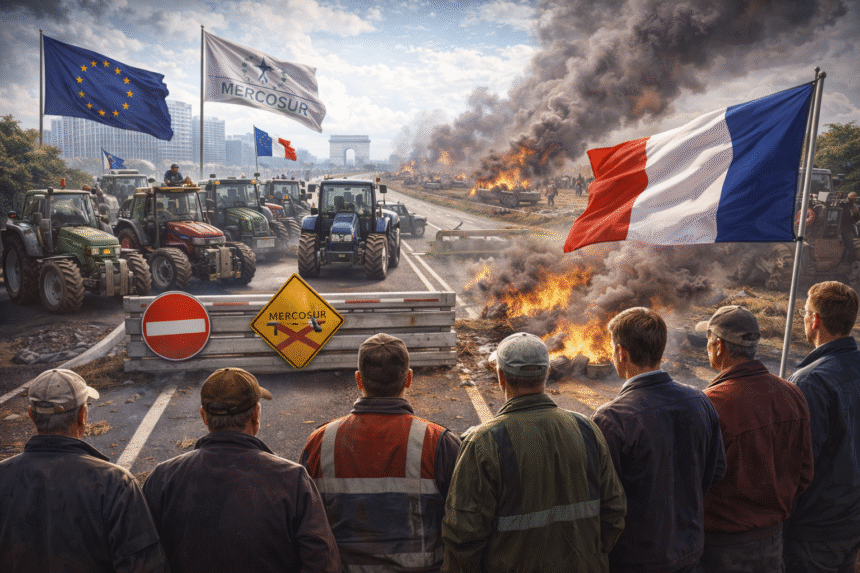
Protests by French farmers, marked by tractor convoys and widespread road blockages, are increasing pressure on the European Union and could delay the ratification of a long-negotiated free trade agreement with the Mercosur bloc.
Across several regions in France, farmers have blocked major highways and access routes, protesting against what they describe as unfair competition from South American agricultural imports. They argue that products entering the EU from Mercosur countries—such as beef, poultry, sugar, and soy—do not meet the same environmental, labor, and animal welfare standards required of European producers.
France, one of the EU’s most influential agricultural powers, plays a critical role in shaping the bloc’s trade policy. The protests have amplified political pressure on Paris, with farming unions urging the government to oppose or renegotiate key elements of the deal. Several French officials have echoed these concerns, warning that approving the agreement in its current form could undermine domestic farmers already struggling with rising costs and climate pressures.
The proposed EU–Mercosur agreement, which includes countries such as Brazil, Argentina, Uruguay, and Paraguay, aims to create one of the world’s largest free trade zones. Supporters say it would boost exports, lower tariffs, and strengthen strategic ties between Europe and South America. However, critics argue that the agricultural concessions come at too high a cost for European rural economies.
At the EU level, the unrest in France risks slowing momentum toward final approval, as the agreement requires backing from member states and the European Parliament. Other countries with strong farming sectors are closely watching the French protests, which could encourage similar resistance elsewhere.
Analysts say the situation highlights a broader tension within Europe between free trade ambitions and domestic political realities. While the EU seeks to expand its global trade footprint, opposition from farmers underscores growing skepticism toward agreements perceived to favor global markets over local producers.
For now, road blockades and mounting political pressure suggest that the EU–Mercosur deal faces further delays, with its future increasingly tied to how European leaders balance trade policy with the demands of their agricultural base.