

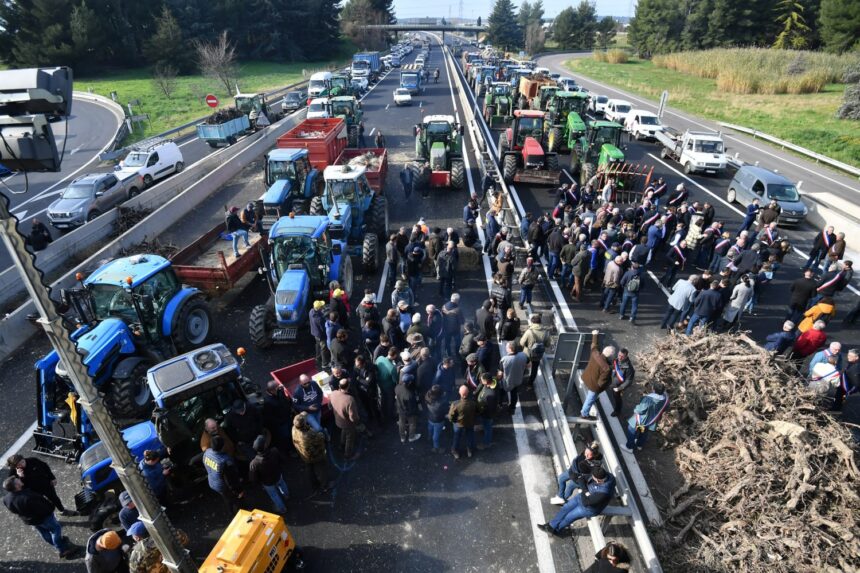
Farmers across France have blocked major roads and staged large-scale protests against a proposed trade agreement between the European Union and South American countries belonging to Mercosur, increasing the likelihood that the deal’s signing could be delayed.
The demonstrations, which took place in several regions including key agricultural hubs, reflect growing anger among French farmers who fear that the agreement would expose them to unfair competition from cheaper agricultural imports produced under less stringent environmental and labor standards.
Farmers’ Concerns
Protesters argue that the EU–Mercosur deal would allow large volumes of beef, poultry, sugar, and soy products from South America to enter the European market at lower tariffs. According to farming unions, this would:
- Undercut European farmers’ prices
- Threaten local livelihoods and family farms
- Undermine EU environmental, health, and animal welfare standards
Farmers also criticize what they see as a contradiction between the EU’s strict climate and sustainability rules and its willingness to import products that may not meet the same requirements.
Political Pressure on Paris and Brussels
The protests place significant pressure on the French government, which has already expressed reservations about the agreement. French officials have repeatedly warned that the deal, in its current form, may be politically unacceptable without stronger safeguards for European farmers.
At the EU level, opposition from France—one of the bloc’s most influential agricultural producers—could complicate or delay the ratification process, which requires approval from member states and, in some cases, national parliaments.
Impact on the EU–Mercosur Deal
Negotiated over more than two decades, the EU–Mercosur agreement aims to create one of the world’s largest free trade zones, covering hundreds of millions of consumers. Supporters argue it would boost exports, strengthen geopolitical ties with South America, and reduce Europe’s dependence on other global markets.
However, the renewed protests highlight deep divisions within Europe over trade liberalization, environmental protection, and food security—divisions that may intensify as economic pressures on farmers grow.
What Comes Next
With road blockades continuing and farmer unions warning of further escalation, European officials may be forced to reopen discussions or introduce additional guarantees to protect the agricultural sector. Until then, the protests have cast fresh uncertainty over the timing—and even the future—of the EU–Mercosur trade agreement.