


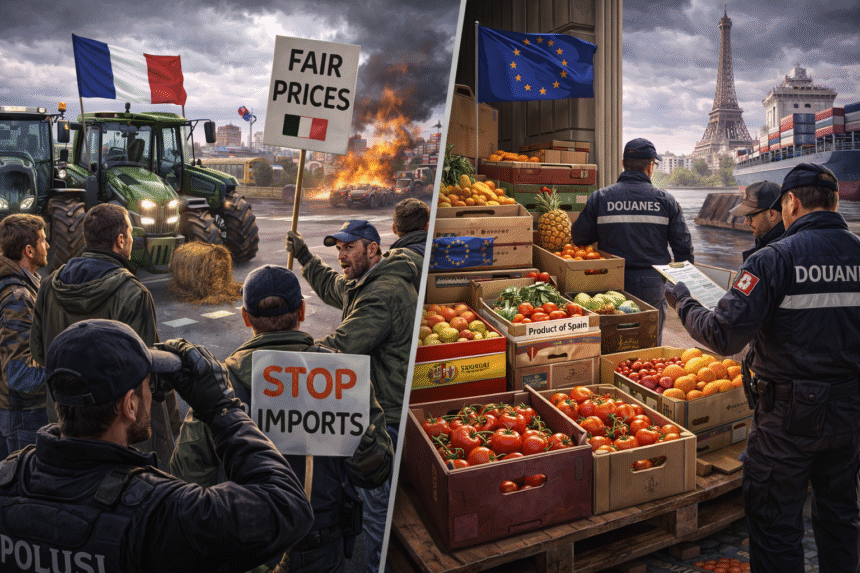
The French government has announced plans to impose stricter monitoring of food imports, a move aimed at easing mounting anger among farmers who say they are being undercut by cheaper foreign products that do not meet the same production standards required in France.
Agriculture Minister officials said the new measures will increase inspections at ports and border checkpoints to verify quality standards, environmental rules, and labeling accuracy. Authorities will also step up enforcement against products suspected of violating European Union regulations.
Farmers Say Competition Is “Unfair”
French farmers — who have staged road blockades, tractor demonstrations, and protests near supermarkets — argue that imported food often benefits from lower labor costs and looser environmental restrictions.
“This is about fairness,” one union representative said. “If French farmers are required to meet strict rules, imported goods should have to meet them too.”
Many farmers also accuse retailers of favoring cheaper imports instead of supporting domestic producers, especially during periods of economic pressure on consumers.
Government Seeks Middle Ground
The government framed the announcement as part of a broader effort to protect rural livelihoods while maintaining France’s commitments within the EU single market. Officials said the goal is not to restrict trade, but to ensure transparency and guarantee that all products — imported or domestic — comply with the same standards.
Prime Ministerial aides acknowledged that the protests reflect deeper frustrations over rising fuel costs, tighter environmental rules, and long-term concerns about farm income.
European Implications
The move could resonate beyond France. Other European countries face similar protests, and policymakers across the bloc are debating how to balance climate policies, food security, and economic realities for farmers.
For now, unions are cautiously optimistic but insist they will continue demonstrations until they see concrete results on pricing and regulatory fairness.
The government plans to present additional measures in the coming weeks, signaling that negotiations with the agricultural sector are far from over.