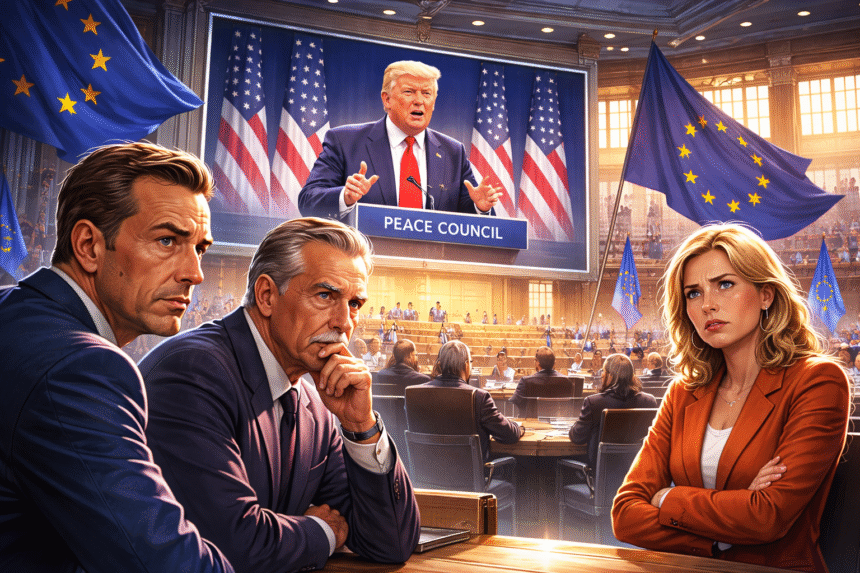
European right-wing political allies have begun expressing growing concern over a series of initiatives promoted by U.S. President Donald Trump, particularly proposals such as the so-called “Peace Council,” which critics argue could weaken Europe’s influence on global affairs and sidestep established international frameworks.
While many European conservative and nationalist parties have traditionally aligned themselves with Trump’s emphasis on sovereignty, strong borders, and skepticism toward multilateral institutions, recent moves from Washington have triggered unease rather than enthusiasm.
Fear of Marginalizing Europe
At the heart of the concern is the perception that Trump’s initiatives risk bypassing traditional diplomatic structures, including the United Nations Security Council, where European powers—such as France and the United Kingdom—retain significant influence. European officials and right-wing lawmakers alike worry that alternative mechanisms led or dominated by Washington could reduce Europe to a secondary role in key global decisions.
Some European politicians fear that such initiatives would consolidate power around U.S. leadership while limiting Europe’s ability to shape outcomes in conflicts involving Ukraine, the Middle East, or broader global security issues.
Tension Within the Right-Wing Camp
The unease is particularly notable because it comes from parties that have often praised Trump’s leadership style. Analysts note that European right-wing movements are now facing a dilemma: balancing ideological sympathy for Trump with the strategic need to protect Europe’s autonomy and relevance.
Several figures within Europe’s nationalist and conservative circles have privately warned that unconditional alignment with Washington could undermine Europe’s long-term interests, especially if U.S.-led initiatives exclude European institutions or decision-making bodies.
Security Council Concerns
The idea of initiatives operating outside or parallel to the UN Security Council has raised alarm in diplomatic circles. European capitals fear that weakening the council’s authority could set precedents that marginalize multilateral diplomacy altogether, leaving Europe with fewer tools to influence crises diplomatically rather than militarily.
France, in particular, has been vocal about preserving the central role of international law and established institutions, a stance that resonates even among some right-wing politicians wary of unchecked U.S. dominance.
A Broader Strategic Shift
The debate highlights a deeper issue facing Europe: its continued reliance on the United States for security and global leadership. Trump’s approach has reinforced calls—across the political spectrum—for greater European strategic independence, especially in defense and foreign policy.
What is emerging is not a rejection of the U.S. alliance, but a reassessment of Europe’s position within it. Even among Trump’s traditional allies in Europe, there is a growing recognition that political alignment does not always translate into shared strategic interests.
Looking Ahead
As global tensions rise and diplomatic frameworks evolve, Europe’s right-wing parties find themselves at a crossroads. Supporting Trump’s initiatives may align with their ideological narratives, but doing so at the cost of Europe’s influence is increasingly seen as a risk.
The unfolding debate suggests that Europe—regardless of political orientation—is becoming more conscious of the need to assert itself as an independent global actor, rather than a passive participant in U.S.-driven initiatives.